Scientific Achievement
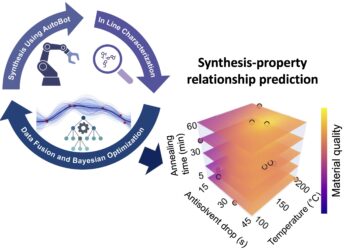
An AI-driven robotic workflow was built to accelerate experiment design and fabricate halide perovskites under less stringent atmospheric control.
Significance and Impact
Machine learning (ML) predicts synthesis-property relationships by experimentally sampling less than 1% of the experimental parameter space. Our multimodal data fusion approach can be expanded to a wide range of optoelectronic materials enabling rational synthesis recipe choice to save time and cost.
Research Details
- The team developed the synthesis and characterization platform AutoBot coupled with Bayesian Optimization (BO) to accelerate experiment design.
- In situ photoluminescence measurements showed that relative humidity decreases the energetic barrier to form alpha-perovskite.
Halder, A., Alghalayini, M.B., Cheng, S., Thalanki, N., Nguyen, T.M., Hering, A.R., Lee, D.-K., Arnold, S., Leite, M.S., Barnard, E., Razumtcev, A., Wall, M., Gashi, A., Liu, Y.-R., Noack, M.M., Sun, S., Sutter-Fella, C.M. Adv. Energy Mater. 2025, 2502294 DOI: 10.1002/aenm.202502294
Research Summary
Traditionally, materials discovery has been a time-consuming, expensive effort based on intuition and the Edisonian trial-and-error experimentation approach. Advancements in computation, artificial intelligence (AI), and robotics allow for a paradigm change in materials science to accelerate materials optimization and discovery. Here, a closed-loop workflow named AutoBot, that integrates synthesis, characterization, robotics, and machine learning (ML) algorithms was built to predict synthesis-property relationships of metal halide perovskites made under different relative humidity (RH). A four-dimensional synthesis parameter space (annealing temperature, annealing time, antisolvent drop time, and RH during film deposition) with more than 5,000 possible combinations was experimentally screened through ML guidance, such that after sampling less than 1% the learning rate dropped to 2%. This shows that our active learning framework enables minimal experimental sampling where Bayesian optimization (BO) identifies the most informative experiments to construct synthesis-property relation predictions.
Feature importance analysis revealed that RH during film deposition contributes the most to the material quality. Subsequent manual and targeted in situ photoluminescence measurements validated the ML predictions and enabled mechanistic insights where the RH was found to decrease the energetic barrier to form heterogeneously nucleating alpha-perovskite phase in the presence of MACl. Overall, the development of AutoBot can be expanded to a wide range of solution-processed semiconductors to accelerate materials development by identifying sweet spots in the synthesis design space.

