Scientific Achievement
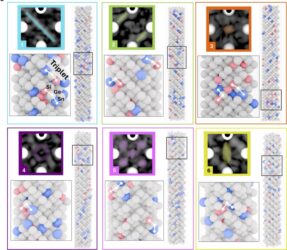
A team of researchers confirmed the presence of short-range order (SRO) in a germanium-silicon-tin semiconductor and identified the actual atomic structure of the SRO motifs.
Significance and Impact
This is the first time short-range order has been identified in a semiconductor, which opens the door to using SRO to tune the band gap of semiconductors.
Research Details
- The researchers used advanced energy-filtered four-dimensional scanning transmission electron microscopy to analyze samples of GeSiSn.
- They compared the experimental data with a virtual 4D-STEM scan based on atomistic structures generated from a highly accurate and efficient machine-learning neuroevolution potential (NEP) developed specifically for GeSiSn alloys.
Vogl, L.M., Chen, S., Schweizer, P., Jin, X., Yu, S-Q, Liu, J., Li, T., Minor, A.M. Science. 389, 6767, 1342-1346. (2025) DOI:10.1126/science.adu0719
Research Summary
On the atomic scale, semiconductors are crystals made of different elements arranged in repeating lattice structures. Many semiconductors are made primarily of one element with a few others added to the mix in small quantities. There aren’t enough of these trace additives to cause a repeating pattern throughout the material, but how these atoms are arranged next to their immediate neighbors has long been a mystery. Do the rare ingredients just settle randomly among the predominant atoms during material synthesis, or do the atoms have preferred arrangements, a phenomenon seen in other materials called short-range order (SRO)? Until now, no microscopy or characterization technique could zoom in close enough, and with enough clarity, to examine tiny regions of the crystal structure and directly interpret the SRO.
Now, researchers have combined energy-filtered 4D-STEM with models that combine machine learning with first-principles calculations to pinpoint structural motifs that would otherwise remain hidden. SRO was previously predicted theoretically, but this is the first time that the individual structure of SRO domains has also been shown experimentally at the scale to directly confirm the theoretical predictions. The results are exciting because the property that’s being changed by this local ordering is the most important property for microelectronics, the band gap, which is what controls the electronic properties of materials.

