Adapted from this Berkeley Lab press release
The Department of Energy (DOE) has renewed funding for the Quantum Systems Accelerator (QSA), a DOE National Quantum Information Science Research Center led by Lawrence Berkeley National Laboratory (Berkeley Lab) in partnership with Sandia National Laboratories. QSA builds and demonstrates quantum technologies and computing prototypes to transform quantum information science into breakthroughs for society. These advances will enable scientists to use quantum computers to design new materials, discover new chemicals and reactions, and accelerate breakthroughs in energy, physics, biology, and chemistry.
The total planned funding for QSA is $125 million over five years, with $25 million in year one and out-year funding contingent on congressional appropriations.
QSA is one of five National Quantum Information Science (QIS) Research Centers established by DOE in 2020 to expand the frontier of what’s possible in quantum computing, communication, sensing, and materials in ways that will advance basic science for energy, security, communication, and logistics. Together, the centers have strengthened the national quantum information science ecosystem, achieving scientific and technological breakthroughs as well as training the next-generation quantum workforce.
QSA brings together 15 partner institutions in North America to drive quantum technology forward. The center combines world-leading expertise and capabilities across national labs, academia, and industry. QSA will also partner with industry, such as Nobel Prize winner John Martinis’ Qolab, to advance quantum technology for DOE and commercial applications. These public-private partnerships will ensure that QSA’s science and technology advances are industry-relevant at every stage.
Over the next five years, QSA’s research will focus on two big goals: building working prototype quantum devices that can solve scientific challenges beyond the reach of conventional computers, and — in close partnership with industry — developing technologies that make quantum systems reliable and scalable for everyday use. With an ambitious target of achieving 1,000-fold performance gains in quantum computational power by 2030, QSA is co-designing scalable systems and benchmarking methods to push the boundaries of what quantum computers can achieve. To get there, they’re scaling up the number of usable qubits and significantly improving their reliability.
For neutral atom systems, QSA scientists aim to build machines holding more atoms that, when combined with error correction, can run 1,000 times more complex calculations with high fidelity than current systems. For trapped ions, they’re developing new ways to encode information that can handle 100 times more data. And for superconducting circuits, they’re improving control systems and reducing the number of qubits needed for error correction to achieve a 1,000-fold gain in computational power. Across all platforms, QSA is also creating new benchmarking approaches to properly validate the performance of quantum computers, advance error correction, and build smarter algorithms to fully take advantage of these hardware breakthroughs.
QSA develops next-generation quantum capabilities by integrating multidisciplinary teams across its partner institutions and leveraging specialized quantum-ready facilities at Berkeley Lab, Sandia National Laboratories, and other leading institutions.
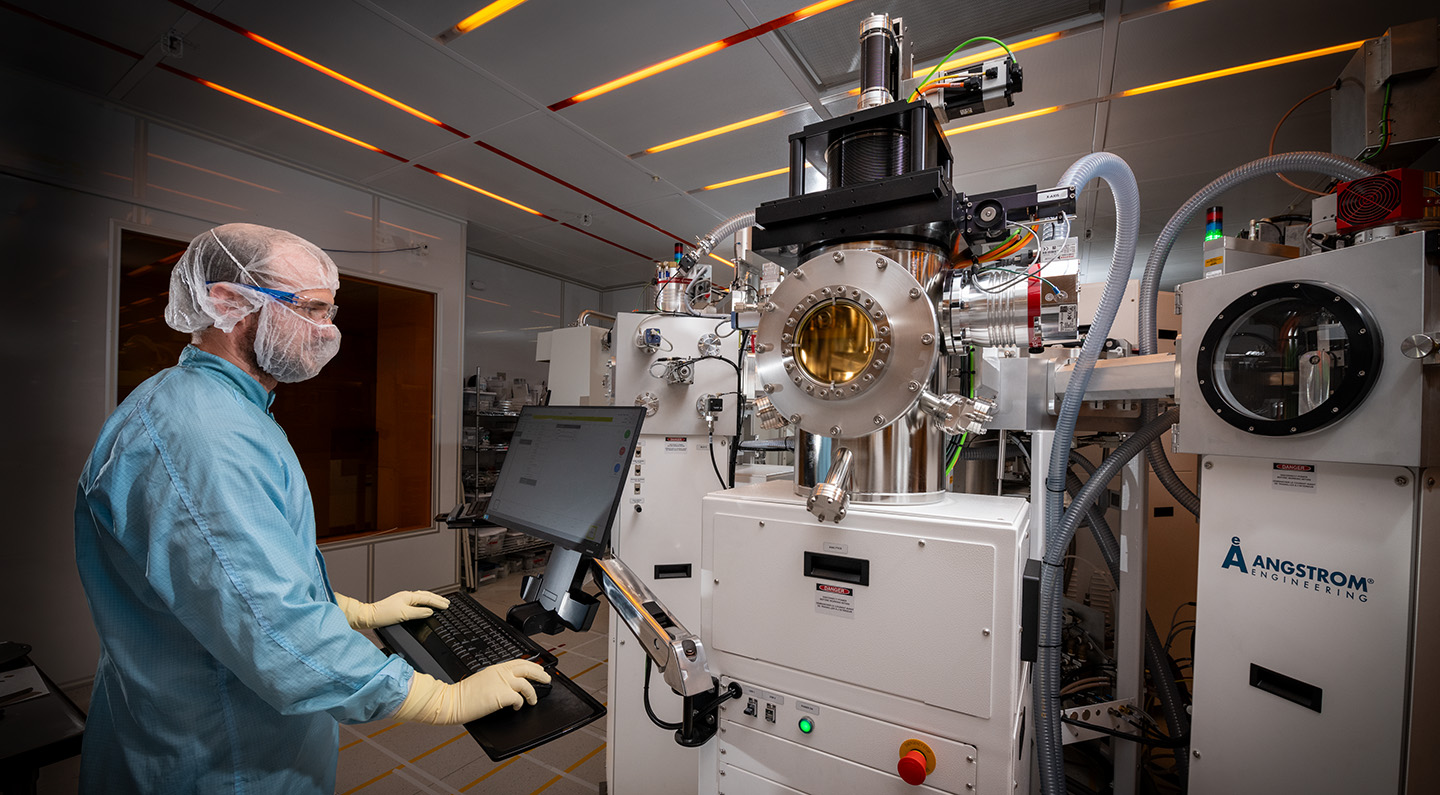
Berkeley Lab, for example, partners with industry and academia and works across the quantum research ecosystem — from theory to application — to fabricate and test quantum-based devices, develop software and algorithms, and build prototype computers and networks. Berkeley Lab’s national user facilities provide state-of-the-art resources for scientists in QSA and beyond to advance the frontiers of quantum science. This includes the Advanced Light Source, the National Energy Research Scientific Computing Center (NERSC), and the Molecular Foundry, which has a QIS cluster tool that enables researchers to experiment with dozens of materials and methods for making qubit components in a single automated system. The Molecular Foundry will also soon add a dilution refrigerator that will enable high-throughput analysis of qubits.
Read the full press release

