By Claire Tsai
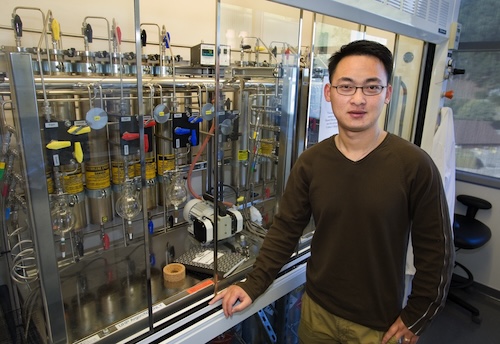
Yi Liu, a senior scientist at the Molecular Foundry, first joined in June 2006, three months after the day the Molecular Foundry officially opened its doors as a research facility. As a brand-new user facility launched under the National Nanotechnology Initiative, Yi learned about the Foundry after having stumbled upon an ad in Chemical & Engineering News while flipping through journals between instrument runs. As a researcher, Liu was intrigued by the prospect of conducting his own research at the Foundry, including working with polymers and other macromolecules to design new materials that can store and control electrical energy safely and efficiently. “A position in a national lab was always something I was curious about, and given the location—the prestigious status of Berkeley Lab, being in the Bay Area, next to Berkeley—the whole ecosystem was very attractive,” Yi remarks.
When he visited for his interview, the Foundry was still “pretty much empty—probably only a few startup postdocs and the first few staff,” but that blank slate—and the chance to help shape a new kind of user facility—became part of the appeal. Yi initially focused on his own research, where his group worked on inventing new types of soft, carbon‑based materials whose atoms are arranged in very precise ways, so scientists can better understand how structure at the molecular level leads to useful properties for future electronics and energy technologies. But as the Foundry grew in size and users, he quickly came to value a model where he could both conduct his own research while working closely with visiting scientists and students. “What I really enjoy about a user facility is that you can both do your own research to inspire others and work with users and the broader community,” Liu notes.
As Liu began working with users at the Foundry, he realized that collaborations were not just an addition to his lab’s work, but a way to advance it. By helping visitors apply his polymer chemistries to their own questions—whether in energy storage, electronics, or new types of soft materials—he found that user projects often sparked ideas his group would not have pursued on their own. Liu now encourages this natural model of collaboration, where he helps users and staff connect across floors and disciples. “When we make a new material, we might talk to someone on the second floor to fabricate devices or talk to friends on the first floor to do imaging. All these characterization tools or expertise are complementary,” he remarks.
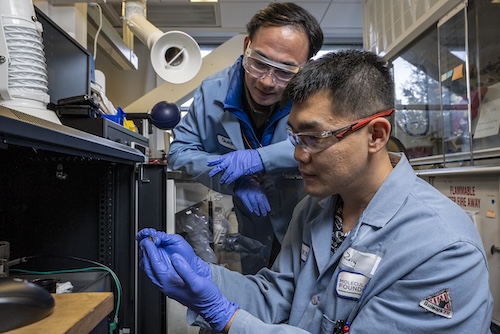
As he looks to the future, Liu sees both opportunity and challenge in further technological developments in areas like quantum computing and artificial intelligence. Yet it is clear to him that this is not possible without the Foundry’s core mission: to provide users with the capabilities they cannot easily access elsewhere, within a broader ecosystem of nearby facilities and high-performance computing resources. After all, it isn’t the specific nanotechnological developments that Liu points to when asked what he is most proud of, but instead it is the people that have passed through his lab and the Foundry—students, postdocs, and visiting researchers who have gone on to careers in industry and academia. “Some of these relationships are not even like formal mentor relationships, but you feel that as they work with you or you work around having them, you have helped them in certain ways,” Liu reflects. For him, the combination of advancing materials chemistry while helping people grow as scientists is what made his years at the Molecular Foundry most meaningful.

