My Foundry Story
The Molecular Foundry user program provides a global cadre of scientists from across academia and industry with the expertise and instrumentation to do their research. In this series of short articles and videos, our staff and users share their stories of why they come to the Foundry. Hear them describe what they are studying, how they use the Foundry, what they love about the Foundry, and more!
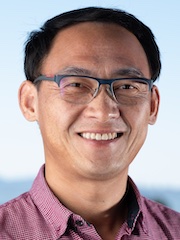
Shaping Materials, Shaping a Facility: Yi Liu on Growing with the Foundry
Yi Liu, now a senior scientist at the Molecular Foundry, first joined in June 2006, three months after the day the Molecular Foundry officially opened its doors as a research facility. As a brand-new user facility launched under the National Nanotechnology Initiative, Yi learned about the Foundry after having stumbled upon an ad in Chemical & Engineering News while flipping through journals between instrument runs. As a researcher, Liu was intrigued by the prospect of conducting his own research at the Foundry, including working with polymers and other macromolecules to design new materials that can store and control electrical energy safely and efficiently.

Growing with the Foundry: Paul Ashby's Journey from Postdoc to Facility Director
Paul Ashby's journey from watching chemistry programs on television as a child to becoming the Facility Director of the Molecular Foundry's Imaging facility reflects a career shaped by unexpected opportunities and collaborative discovery. Over two decades at the Foundry, he has advanced techniques in high-speed Atomic Force Microscopy for capturing nanoscale dynamics in real time while fostering the interdisciplinary environment at the Foundry where, he notes, "lots of good ideas come from just sitting down and having a conversation."

Bringing Space Research Down to Earth – One Atom at a Time
Hope Ishii, a user at the Foundry’s National Center for Electron Microscopy (NCEM) and a research scientist at the University of Hawai‘i at Mānoa, relies on electron microscopes at the Foundry to advance her research on extraterrestrial materials.

How mimicking nature with chemistry might transform the way we live
A Q&A with Ron Zuckermann, one of the scientists behind the discovery of peptoids, protein-mimicking materials. Peptoids are synthetically produced polymers that mimic polypeptides, naturally occurring proteins. Think of them as designer proteins– scientists can control the exact chemical structure, designing any peptoid they want with customized properties and functions tailored to specific applications. Beyond being remarkably easy to make, peptoids can be crafted with incredible chemical diversity, naturally mimic the structure of biological proteins, resist breakdown in harsh conditions, retain powerful biological activity, and even organize themselves into protein-like nanostructures.
Was this page useful?

