Terahertz Scanning Tunneling Microscope (THz-STM)
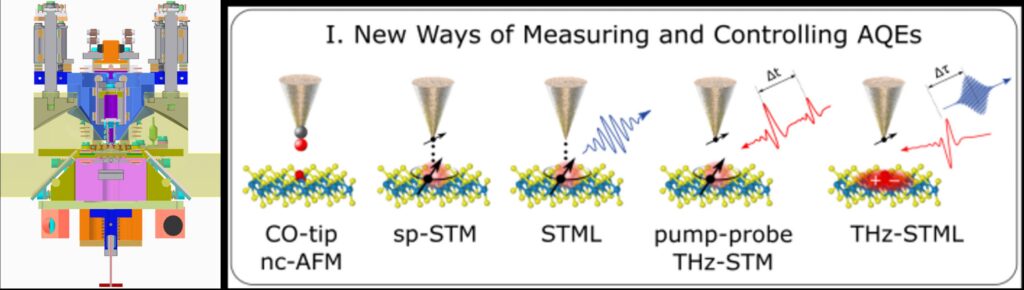
The Molecular Foundry’s Terahertz Scanning Tunneling Microscope (THz-STM) provides a uniquely powerful platform for investigating quantum materials by combining atomic spatial resolution, sub-micro-electron-volt energy resolution, and sub-picosecond time resolution. Operating at cryogenic temperatures of 4 to 5 Kelvin, the instrument features an integrated RF line and a superconducting magnet capable of applying up to a 1 Tesla field directly to the tunneling junction. To achieve highly efficient optical control, two parabolic mirrors with a 0.3 numerical aperture allow to couple light into and out of the junction. Researchers can excite samples using sub-400-femtosecond laser pulses spanning a broad 300 to 2000 nanometer wavelength range with variable repetition rates up to 1 megahertz, or utilize sub-picosecond terahertz pulses that effectively act as ultrafast tip-sample bias switches. The resulting optical emission is captured by a robust detection suite that includes an Andor spectrometer for visible light, an InGaAs detector for the infrared, and an advanced single-photon superconducting detector that enables highly sensitive, time-resolved g(2) photon correlation measurements across all channels. This setup is specifically tailored for studying the ultrafast evolution of quasiparticle excitations, probing individual quantum emitters driven by tunneling current, optical, or terahertz excitation, and exploring time-resolved transport and excitation amplitudes in correlated electron systems. Prospective users planning to apply for this capability should anticipate that a comprehensive and meaningful scientific study utilizing this instrument typically requires a commitment of approximately two months.
Createc Low Temperature STM/AFM
The Createc Low Temperature STM/AFM is a customized microscope that operates in an ultra high vacuum and at temperatures between 4 K and 370 K. The instrument is a combination of PAN-type slider STM with highest spectroscopy performance (1 meV energy resolution), scan range over 800 nm at 4K, and a q plus AFM that allows to perform ultra high resolution AFM. In addition, we incorporated optical access to both couple light directly into the tunnel junction or collect light from the tunnel junction, enabling to study the local electronic structure with atomic resolution while being optically excited. Both, STM and AFM provide subatomic spatial resolution due to the outstanding stability (dz<1 pm) AFM and STM can per operated simultaneously without cross-talk using constant frequency or constant height control.

