Scientific Achievement
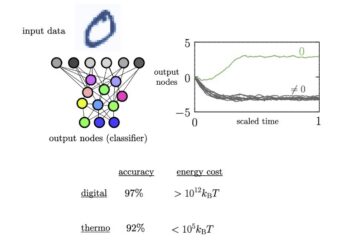
We showed that physical systems driven by thermal noise can do AI inference with much less energy than digital neural networks.
Significance and Impact
Thermodynamic computing could enable ultra-low-energy AI inference, by performing calculations using the natural dynamics of noisy hardware instead of running a high-power digital program on top of it.
Research Details
We developed computational methods to train thermodynamic computers, networks of fluctuating nonlinear units, to do AI inference at designated observation times. By tuning parameters with genetic algorithms, our computational thermodynamic neurons correctly classify 93% of handwritten number samples in the MNST test set.
Whitelam and Casert. Nat. Comm. 17, 1189. (2026) DOI:10.1038/s41467-025-67958-0
Whitelam, Phys. Rev. Lett. 136 037101 (2026) DOI: 10.1103/kwyy-1xln
Research Summary
Conventional computers are built to suppress thermal noise — the random jiggling of electrons and other physical degrees of freedom that arises simply because a device is at finite temperature. Thermodynamic computing inverts this philosophy entirely, treating that noise not as a nuisance but as the engine of computation. Two recent papers by Whitelam and collaborators at Lawrence Berkeley National Laboratory make a compelling case that this approach can handle the kinds of tasks — classification and generative modeling — that have come to define modern AI.
The Nature Communications paper tackles discriminative computation. The core building block is a “thermodynamic neuron”: a physical variable confined by a nonlinear quartic potential and coupled to a heat bath. Because the quartic potential produces a nonlinear input-output relationship, networks of these neurons can approximate arbitrary continuous functions — just like a conventional deep neural network. Critically, the computation doesn’t require the system to reach thermal equilibrium; results are read out at a prescribed time along the out-of-equilibrium trajectory. Parameters are tuned via a genetic algorithm, and the authors show the system can classify MNIST handwritten digits at ~93% accuracy, comfortably beating a linear baseline and establishing proof-of-principle for thermodynamic machine learning.
The Physical Review Letters paper pushes the frontier further into generative modeling. Modern AI image generators (like diffusion models) work by learning to reverse a noising process, using a neural network to guide each denoising step. Whitelam’s generative thermodynamic computer dispenses with that neural network entirely: instead, the physical system’s own natural time evolution — governed by Langevin dynamics — does the denoising. Training maximizes the likelihood that the system retraces a noising trajectory in reverse, and a neat thermodynamic bonus emerges: this training objective also minimizes heat dissipation during generation. If built in analog hardware, such a device would generate structured data samples (images, for instance) from thermal noise alone, with no external control required. Together, the two papers represent a significant conceptual advance. They show that thermodynamic computers are not limited to linear algebra in equilibrium — they can perform the full suite of nonlinear, generative, and discriminative computations that underpin modern AI, potentially at drastically lower energy costs than silicon hardware. The path to physical implementation using existing components such as nonlinear RLC circuits or Josephson junctions makes this more than a theoretical curiosity.

