Scientific Achievement
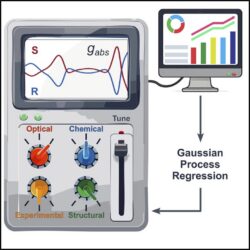
Statistical optimization of chiral 2D metal halide perovskite thin films reveals solvent choice, film thickness, and annealing temperature as key drivers of chiroptical performance.
Significance and Impact
Establishing a predictive framework for chiroptical optimization accelerates the development of chiral perovskites for next-generation spin-optoelectronic and spintronic device applications.
Research Details
- Multimodal statistical analysis (Pearson correlation, ANOVA, Gaussian process regression) combined with in-situ characterization enabled quantitative, predictive modeling of synthesis-property relationships.
- Acetonitrile solvent yielded the highest and most reproducible chiroptical responses, outperforming DMF and ACN:DMSO mixtures.
- A nonlinear optimum exists: intermediate film thickness maximizes chiroptical response, while excessive annealing triggers degradation into an undesirable 1D phase.
Moral, R.F., Alghalayini, M.B., Nurdillayeva, R.N., Lee, D-K, Kodalle, T., Marchezi, P.E., Fenning, D.P., Noack, M.M., Schwartz, C.P., Sutter-Fella, C.M.. Matter 9, 102676 (2026) DOI:10.1016/j.matt.2026.102676
Research Summary
Researchers wanted to understand how the way you make a material affects its special optical properties. The material in question is a class of semiconductors called chiral 2D metal halide perovskites — thin films that can interact differently with left- and right-handed polarized light, a property called chiroptical activity. This is tricky to control, and results tend to vary wildly from lab to lab. To tackle this, the team systematically tuned several “knobs” in the fabrication process — things like which solvent they dissolved the material in, how hot they heated the film afterward, and how thick the film was. Rather than just trying combinations by trial and error, they used statistical tools (including correlation analysis and machine learning-adjacent methods like Gaussian process regression) to figure out which knobs actually matter and how they interact.
The biggest finding was that solvent choice is the single most important factor. Films made using acetonitrile produced the strongest and most consistent chiroptical signals compared to other solvents like DMF. Once they fixed the solvent, they found that both annealing temperature and film thickness mattered — but in a nuanced way. There’s a “sweet spot” for thickness: too thin and the signal is weak, too thick and it drops off again. Temperature is a double-edged sword too — higher temperatures boost the chiroptical response, but push it too far and the material chemically transforms into a different, less useful structure. This matters because chiral perovskites are promising building blocks for future technologies that exploit the “spin” of electrons, such as spin-based LEDs or quantum computing components. The problem is that these materials have historically been hard to optimize due to their sensitivity to processing conditions. By creating a clear, data-driven roadmap linking how you make the film to how it performs, this work gives other researchers a practical guide to reliably produce high-quality chiral perovskite films — accelerating progress toward real devices.

