By Claire Tsai
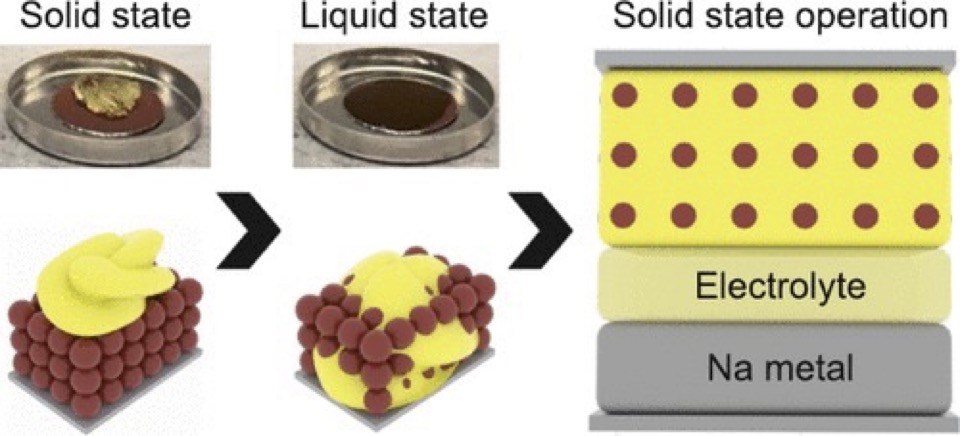
As we push for greater energy independence, the grid needs large-scale batteries to store excess electricity and ensure a steady power supply. Today, most batteries rely on lithium ions moving through an electrolyte to balance the charge while charging and discharging. To improve the safety of batteries, solid-state electrolytes are highly regarded, yet their susceptibility to cracking and their inability to properly interface with anode and cathode materials has led to questions as to their long-term potential. Moreover, restricting designs to lithium-based materials might limit deployability, given the volatility of battery supply chains. But what if solid electrolytes that usually crack and are hard to manufacture could instead melt, flow, and reshape themselves? What if a battery’s ion conductor could behave as both a liquid and a solid? What if those designs could also apply to abundant ions, like sodium? A team of scientists at the Molecular Foundry, in collaboration with the Pacific Northwest National Laboratory (PNNL) and the University of Houston, have recently turned that vision into a reality. In a paper published in ACS Energy Letters, the researchers have proposed a new class of “thermoformable” solid electrolytes called ORION (organo–ionic) materials for solid-state sodium batteries that promise safer, and more scalable energy storage.
Inside every battery is an electrolyte, which is a material that helps charged atoms move between the battery’s two electrodes. In most batteries, the electrolyte comes in the form of a liquid, but can easily leak, dry out, or catch fire. While solid electrolytes are a safer alternative and work well for compact devices, the need for larger-scale energy storage in recent years has pushed researchers to look for safer and more efficient materials. “Because of the scale, there is an obvious need for TWh‑scalable solutions to add to what is being done with Li‑ion systems,” said Senior Staff Scientist Brett Helms. ORION materials focus instead on batteries that use sodium, a more common element similar to what is found in table salt, which could be scaled more easily. This is because the ORION electrolyte is a solid that softens when heated and hardens again when cooled, a bit like a heat‑softened plastic. “We considered whether it would be possible to create solid electrolytes in a manner similar to liquid electrolytes and derive liquid‑like transport of sodium ions to improve battery performance,” said Helms. “The advantage of such an approach would be that the softer solids could make better interfaces with the rest of the battery materials and open the door to simpler processing of solid‑state batteries.”
To build ORION, the researchers combined three main ingredients: a zwitterion, which is a special organic molecule with both positive and negative charges, a sodium salt called NaTFSI, and small ether‑based molecules that help guide sodium flow. “We found that diverse sodium salts useful in batteries can dissolve in the zwitterionic matrix at high concentrations. At these concentrations, we thought it might be possible to get liquid‑like conductivity in a solid to support high current density in the battery,” Helms explains. After determining the right mix of concentrations, the material became soft and processable at high temperature and turned into a solid that conducts sodium ions efficiently at normal battery temperatures.
Interested in Becoming a Foundry User?
Join our collaborative, multidisciplinary environment.
Learn more >
To verify the behavior of the ORION electrolyte, the scientists made nuclear magnetic resonance (NMR) measurements and discovered that sodium ions fall into two main groups: structural and mobile. Roughly 40% of sodium contributes to the material’s structure, while the other 60% is mobile and carries electrical charge to support current flow. “We believe that this immobile sodium population plays an important structural role by maintaining the mechanical and architectural integrity of the electrolyte, thereby providing a stable matrix for the transport of the mobile sodium,” first author Dong-Min Kim says. In simple test cells with sodium on both sides, the symmetric cells could charge and discharge steadily more than 400 times at 60 °C without short‑circuiting. In full cells with an organic cathode, they maintained stable performance for at least 200 cycles with high efficiency.
This work was made possible through collaboration and tools from multiple national labs and universities. “We benefitted tremendously from collaborations across national labs and university partners built through the Energy Storage Research Alliance,” said Helms. Scientists from PNNL, like Ying Chen, also contributed significantly to the discovery of sodium ion mobility as a key driver of conductivity as well. “Working with these different labs was an incredible experience. The specialized expertise at each facility allowed for advanced characterizations that led to our deep understanding of the ORION electrolytes,” Kim adds.
Now, the scientists are exploring how to pair the ORION electrolyte with organic cathodes to avoid relying on transition metals altogether. “We have patented the invention and are exploring the materials alongside organic cathodes so that the transition metal burden for sodium batteries is alleviated and therefore easier to scale to meet our energy storage needs,” said Helms. “We have all of the resources we need for organic battery materials. That’s certainly an advantage, both near‑term and long.”

