Discovering the Future, Atom by Atom
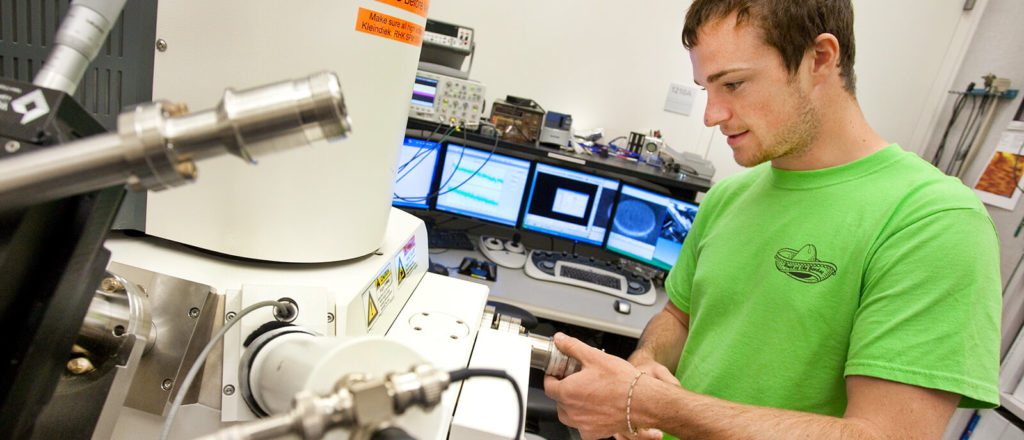
The six-story, 94,000 square-foot Molecular Foundry building at LBNL overlooks the UC Berkeley campus and, from a distance, the San Francisco Bay. Directly adjacent to the Foundry is the NCEM complex that was established in 1983 to maintain a forefront research center for electron microscopy with state-of-the-art instrumentation and expertise. Merged with the Molecular Foundry in 2014 to take advantage of growing scientific and organizational synergies, NCEM at the Foundry features 10 electron microscopes, many of which are world-leading.
Each of the six floors of the Foundry building, as well as NCEM, is managed as a technically distinct “facility” by world-class scientists equipped with state-of-the-art instrumentation, laboratories, and computational resources. Five research themes at the forefront of nanoscience integrate users, staff and techniques across all seven technical facilities, embodying the Foundry’s core capabilities and synergistic activities in synthesis, characterization, fabrication, and theory. They were developed through a comprehensive planning process undertaken in 2021, and will be regularly reviewed to evaluate their novelty, relevance, productivity, and impact. New capabilities and expertise developed in the context of internal research activities significantly augment the Foundry User Program. The themes are summarized below. To download the Molecular Foundry’s entire Strategic Plan, please use the link below.
Molecular Foundry Strategic Plan
- Design and Control of Materials for Quantum Coherence and Sensing – The Foundry combines atomic-scale synthesis & design, multimodal characterization, AI/ML accelerated theory, device integration and feedback to close the loop in developing the fundamental understanding of decoherence and precise control of material interfaces in quantum devices.
- Structure, Function & Dimensionality for Microelectronics – The Foundry aims to advance microelectronics by bringing together several key areas: developing new materials, understanding how surfaces interact, building systems from molecules up to larger structures, and creating patterns that can be manufactured at scale. This integrated approach responds to both architectural design needs and practical manufacturing requirements.
- Accelerating Precision Design and Discovery of Materials – The Foundry is a leading institution in the synthesis of a wide range of materials, including inorganic nanoparticles, hybrid organic-inorganic composites, small molecules and polymers, sequence-specific biopolymers, and engineered living materials. The Foundry’s suite of robotic synthesizers offer precision control over synthesis conditions and a window for understanding structure-function relationships.
- Cross-Cutting Core Capabilities – The Foundry’s cross-cutting core capabilities – spanning data infrastructure, innovative tool development, state-of-the-art materials characterization, and advanced theory and modeling – form the foundation that supports and connects every thrust of Foundry research. These capabilities ensure that the Foundry remains agile in responding to emerging scientific opportunities and continues to lead in the design, synthesis, and understanding of nanomaterials.
The Molecular Foundry’s Strategic Plan is a broad scientific and organizational outline as well as a living document that will serve to guide the Molecular Foundry while enabling us to adapt to the rapidly changing research landscape. The foundation of this strategic plan stems from aligning ourselves with national priorities. We are also aware that the various areas, divisions, programs, and centers at Berkeley Lab all have priorities and strategic plans, and we have made an effort to position our plan within that context. This cycle of feedback remains a central part of the organization. Input from the user community is always welcome. Staff can be contacted directly here.
The Future of Cryogenic Microscopy
Sixty years of attempts to make part of the microscope cold have not overcome the impediments posed by a room-temperature microscope. Making the entire microscope cold (and superconducting) will eliminate thermal drift, shield electromagnetic interference, and enable 3D atomic resolution imaging at a range of sample temperatures – down to those of quantum phenomena. The next quantum leap in electron microscopy demands a non-incremental change, and we need to think of how to make a microscope for the quantum future. Read about our vision here.

