Scientific Achievement
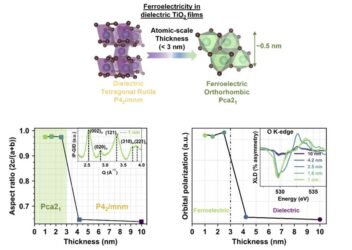
Researchers discovered that titanium dioxide films becomes ferroelectric when thinned below three nanometer, unlocking potential for next-generation energy-efficient computing chips.
Significance and Impact
ALD-grown TiO2 is a common material in semiconductor industries, this could enable denser, faster, lower-power devices in future computing chips without retooling existing chip fabrication lines.
Research Details
- Films were grown using atomic layer deposition at below 400°C, low enough to be compatible with standard chip manufacturing.
- The ferroelectric behavior remained stable on silicon and amorphous surfaces, confirming the material’s versatility for integration across a wide range of devices.
- Reducing the film thickness below 3 nm triggered a phase transition causing the material’s crystal structure to break structural inversion symmetry and stabilize a ferroelectric phase.
Das, K., Reidy, K., Husain, S, Park, J.H., Jayakumar, H., Thampy, V., Klewe, C., Ramesh, R., Minor, A.M., Raja, A., Salahuddin, S. Science 392, 6795, 280-284. (2026) DOI:10.1126/science.aec9417
Research Summary
Researchers have discovered that titanium dioxide (TiO₂) — a material already ubiquitous in semiconductor manufacturing — can become ferroelectric when thinned to just one nanometer. Ferroelectricity, which allows a material to hold a switchable electrical polarization, has important applications in next-generation electronics. What makes this finding striking is that TiO₂ was previously considered a simple dielectric — a material that stores charge but cannot switch its polarization — making the discovery of ferroelectric behavior in it both surprising and significant.
The key to unlocking this behavior was thickness: reducing the TiO₂ film below 3 nanometers triggers a phase transition in which the crystal structure breaks its own internal symmetry, giving rise to voltage-switchable polarization. The researchers grew these ultra-thin films using atomic-layer deposition at temperatures below 400°C — a process already standard in chip fabrication. Critically, the ferroelectric behavior remained stable on both silicon and amorphous surfaces, demonstrating compatibility with a wide range of materials used in modern electronics.
The practical implications are considerable. Because TiO₂ is already a familiar, well-understood chip material, this discovery could pave the way for denser, faster, and lower-power memory devices without retooling existing chip fabrication lines. Ferroelectric materials are of growing interest for non-volatile memory, neuromorphic computing, and energy-efficient electronics — and finding these properties in such a common material dramatically lowers the barrier to real-world adoption.

