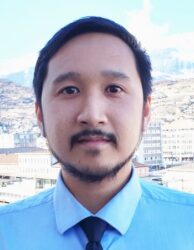
By Kristopher Benke
Daniel Sun started at the Foundry as a research assistant back in 2013, where he and his principal investigator discovered a material that could selectively extract lead and other heavy metals from water, including samples straight from nearby Strawberry Creek. Next, he ventured off to Switzerland for his PhD, but eventually came back to the very same desk and fume hood at the Foundry, where he continues to learn more about what this material can do. He has now founded his own company, Sunchem, to continue to develop the materials and incorporate them into processes that produce highly pure metals like gold, copper, and silver for use in energy, defense, data centers, and other advanced technologies.
Tell me about the material you and your principal investigator discovered at the Foundry. How did you originally figure out what it could do?
This class of materials is called metal organic frameworks. It’s one of the technologies that we’re commercializing right now, and it’s one of the economic drivers of our process. When we first discovered the material, we really just wanted to understand it. It was an orange material, iron- and carbon-based, and we added another carbon-based molecule to it, specifically dopamine, and it turned black. We were like, whoa!
Then we found that it was a really crazy heavy metal scavenger. I still remember it to this day, over a decade ago, me going to Strawberry Creek and getting water from there with lead in it, and then treating that with the powder that we made.
So it warranted more study, right? And then we showed that it was the fastest material in the world for that type of heavy metal capture. It was very selective, so it only picked up lead and rejected a lot of other different hard ions you typically see in water. Then we realized we could tune it, and it was during my PhD that we tuned it to capture gold.
What did you learn from testing the material using the water in Strawberry creek?
Strawberry Creek is just outside Berkeley Lab in the botanical gardens, so I just went out there and got some water at the direction of a Berkeley scientist. Because the thing is, you can simulate the water, but the best way to do the experiments is to actually take real surface water because it has all these different ions and organics in it. So if you can selectively extract lead out of creek water, you could probably extract it out of anything. We spiked it with lead for the tests, but there was already lead in it, which is kind of crazy.
How else did your time at the Foundry prepare you to launch your company?
The Foundry has the resources and instruments to completely characterize feedstocks at the nanoscale, like a bunch of different inputs, whether it’s mining inputs, electronic waste, or dirt from Arizona or Mariposa County that has copper and gold in it. They’ve really done a great job of showing the capabilities of the Foundry to understand these things on the nanoscale, like how much metal is in there? What is the oxidation state of the metal? What is its electronic structure? What’s the minerality or the crystallinity? What other minerals are present?
I think that allows them to expedite their R&D for a bunch of different industrial situations. They’re really solving some of the hardest problems in industries utilizing the resources of the Foundry. Kudos to the technical team.
How has Sunchem grown since then? Where are you now?
The great thing about the Foundry is that it offered resources and instruments and even expertise that really helped us be successful and create the foundation for where we are today. We have raised 3.75 million to date through non-dilutive and dilutive funds, so through grants and investors. Now we’re capable of processing kilograms of feedstocks, such as electronic wastes, circuit boards, evaporative scrap, whatever it might be, and we’ve discovered that our material can concentrate and separate gold really well.
I always say you can be the smartest scientist or engineer in the world, but if you don’t have resources, it’s really tough to do anything. I think the Foundry gave us the resources to build the foundation we have today. Now we have a 11,400 square foot facility in West Berkeley in what used to be an old auto repair shop and we can process 30-50 lbs of electronic waste or scrap per day producing hundreds of dollars of gold and copper
What are your plans for using this new facility?
There, we’re building different lines that can process a variety of different feedstocks using the technologies we’ve developed here at the Foundry. For example, one line will be able to process circuit boards to get the gold and copper out. One line that we’re looking to finance is for recycling solar panels to get silver and silicon out at high purities. We think we can eventually process anywhere from 250-1,000 metric tons a year at that plant. So, it’s a really good place to start building our lines and demonstrate the technology we’ve been piloting at the Foundry at a larger industrial scale.
We now have seven full-time employees, and we’re continuing to scale up our process. We’ve had multiple students go through our lab, and some have become full-time employees or gone on to do their PhDs. It’s been great to help develop the next generation of scientists and engineers.
Can you tell me more about how you grew Sunchem to seven full-time employees?
From 2020 to 2022 I was really moonlighting Sunchem, so in other words, I wasn’t getting paid for it. I hadn’t raised any money yet or gotten any grants, but I was actually working part-time for a battery startup. That’s what paid the bills. I worked with them 50% of the time as a private contractor. I wasn’t getting any benefits or anything, and I was working on Sunchem the other 50% of the time.
It was in 2022 when we got some non-dilutive funding, including an NSF grant, a fellowship through Cyclotron Road, and the Activate program. That allowed me to hire my first two employees, a research scientist position and a research engineer position. The research scientist eventually became my co-founder and chief technology officer, and she is now leading the technology team.
Then, at that point, we derisked the technology further, got industry partners, raised a little bit more money after getting the non-dilutive funding. We got some state funding from California–$150k and then another half a million. Then we grew the team to seven, including a PhD level chemist, some more technicians, our associate-level staff, and finally our VP of engineering who is helping to lead the technical development efforts as well as focusing on scaling up.
It’s been an awesome journey! It’s been a roller coaster, but I’m having a lot of fun, so I think that’s really important. And we get to have a lot of fun here at the Foundry, too.
Interested in Becoming a Foundry User?
Join our collaborative, multidisciplinary environment.
Learn more >
What did derisking mean for Sunchem? What did you have to figure out before you could continue expanding?
After my PhD, I made this powder, which picked up heavy metals pretty well, but all the experiments I’d done up until that point involved taking that powder, putting it in a vial and shaking it, and measuring the concentration of the metal before and after. So if you actually want to consider these materials for industrial implementation, you have to consider the performance of the material under a dynamic, continuous flow operation.
When I came here, my goal was to figure out a way to engineer that fine powder into a column or a filter device, and so that meant structuring the materials. We actually published a paper in Nanotechnology, an IOP publication, and we demonstrated that indeed, the material does work under continual operation, or in other words, as a filter device.
That was the big derisking, which was figuring out if this worked in an industrial situation. Then after that, we started testing it with real feedstocks like electronic waste and tailings, but what we learned was that once you purified the gold from the MOF, it had so much gold in it that you’re able to make very high pure gold, beyond 99.9% pure.
And I think that’s quite incredible because the only other way to do that is through a very costly electrochemical process. We serendipitously found that not only does this thing scrub gold out of water really well, and that it allows us to process things like electronic waste cost-effectively, but it can also create high pure metal and we can refine the gold from it.
It seems like you’ve spent a lot of your career at the Foundry–was there another option available that would have given you the means to grow your company?
We would have had to pay a lot of money to get our own lab space to do our work. I’m talking millions of dollars. The Foundry allows you to be lean and mean, and it lets companies like us do the proof of concept work without spending a lot of capital. I don’t know any place in the world that does something like the Foundry. It’s such a special place–it allows for innovation.
If you look at all the companies that have come through the Foundry and how much money they have raised, I bet you it’s in the billions. It’s one of its selling points: we have access to some of the best resources in the world–more than 8 million dollars in resources. It’s routinely maintained, and there are experts running it–it’s awesome.
I’m gonna reiterate this: without the Foundry we would be more behind, and we just wouldn’t be in a good place. We probably wouldn’t have raised money and probably would have spent a lot more money.
You could think of it this way: if I had to go build my own facility, which we’re doing right now, and raise money at it that early, I would have to give up so much equity. I would have to form a board; people would have to tell me what to do, and could of led us down a different path
The Foundry is so important for us and other future startups. It’s a little selective and very competitive, but obviously, that means the best ideas move forward, and that’s what it should be like. The fact that they’re hitting 20 years is incredible, and I’m honored to be part of this community.

