Scientific Achievement
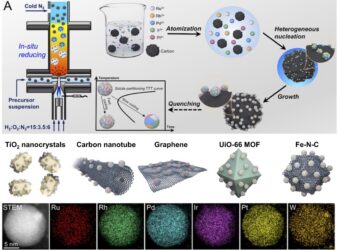
Researchers developed a modified flame aerosol process to produce sub-4nm supported high entropy alloy (HEA) nanoparticles.
Significance and Impact
This scalable, low-cost synthesis method could accelerate industrial adoption of HEA catalysts across energy, electronics, and sensing applications by overcoming size and support limitations.
Research Details
- The non-equilibrium flame aerosol reactor combined kinetic mixing, entropy-driven alloying, in-situ H₂ reduction, and heterogeneous nucleation to make 2-4 nm HEA nanoparticles on diverse supports.
- An entropy-induced reduction mechanism enabled incorporation of typically oxidation-resistant elements (W, Ce, Zr) into single-phase alloys, expanding compositional space to 10-element nanoparticles.
- A 5-metal RuPdOsIrPt/graphene electrocatalyst outperformed commercial RuPt/carbon by 2x with superior stability after 10,000 cycles.
Liu, S., Liang, J., Kaufman, J.L., Jiang, Q., Wierzbicki, D., Tung, K-L., Chen, K., Sun, H., Xuan, Z., Khan M.A., Kang, S., Chen, W., Wu, G., Urban, J.J., Swihart, M.T., Dun, C., Nat. Comm (2026) DOI: 10.1038/s41467-026-72958-9
Research Summary
High-entropy alloy (HEA) nanoparticles, materials combining five or more elements in a single crystalline phase, offer exciting properties for catalysis and energy applications, but synthesizing them at small, uniform sizes with high loading on diverse support materials has remained challenging. Traditional methods struggle with elemental immiscibility, oxidation resistance, and particle aggregation.
This study introduces a modified flame-assisted spray pyrolysis reactor that separates flame and particle-formation zones while using a fuel-rich hydrogen flame to create an in-situ reducing atmosphere. This approach allows aqueous metal precursors to be rapidly converted into HEA nanoparticles (2-4 nm) directly loaded onto a wide range of supports—including carbon, graphene, TiO₂, MOFs, and even simultaneously-formed mesoporous silica, in a single continuous step.
The research team shows that rapid reaction kinetics (occurring within milliseconds) combined with high configurational entropy suppress particle growth far more effectively than conventional equilibrium synthesis methods. They also demonstrate an “entropy-induced reduction” mechanism, using DFT calculations to show how the HEA environment weakens metal-oxygen bonds, enabling incorporation of oxidation-resistant elements like tungsten, cerium, and zirconium, expanding possible HEA compositions to millions of combinations. As a practical demonstration, a five-element RuPdOsIrPt/graphene catalyst showed exceptional activity and stability for hydrogen oxidation reactions, significantly outperforming commercial catalysts, highlighting the method’s promise for scalable industrial catalyst production.

