Seminar Date: Tuesday, November 3, 2026
Time: 11:00 AM PT
Location: 67-3111 & Zoom
Talk Title: Quantum Advantage, Verifiability, and the Road to Fault Tolerance
Zoom link
Add this event to your calendar
Abstract:
The era of quantum fault tolerance is taking shape, driven by rapid advances in quantum hardware, algorithms, and error-correction techniques that are steadily transforming quantum computing from a scientific ambition into a practical computational paradigm. In this talk, I will discuss IBM’s path from quantum utility to quantum advantage and ultimately to large-scale fault-tolerant quantum computing. I will argue that the field has already entered the utility era, where quantum computers can execute circuits beyond brute-force classical simulation [1]. I will then examine IBM’s definition of quantum advantage, emphasizing not only superior computational performance but also rigorous validation and trust in quantum outputs through the emerging framework of trusted quantum computation [2]. Particular attention will be given to verifiability as the key ingredient for establishing credible claims of quantum advantage in regimes where classical verification becomes infeasible [2]. Finally, I will outline IBM’s roadmap to fault tolerance, highlighting advances in quantum low-density parity-check codes, scalable modular architectures, and real-time error correction that underpin the development of systems such as Starling [3].
References
[1] Kim, Y., Eddins, A., et al. “Evidence for the Utility of Quantum Computing Before Fault Tolerance.” Nature 618, 500-505 (2023). DOI: 10.1038/s41586-023-06096-3. [research.ibm.com]
[2] Martiel, S., et al. “Sampling Hard Circuits with Verifiably High Fidelity.” arXiv 2607.25941 (2026). DOI: 10.48550/arXiv.2607.25941. [arxiv.org]
[3] Bravyi, S., Cross, A. W., Gambetta, J. M., Maslov, D., Rall, P., & Yoder, T. “High-threshold and Low-overhead Fault-tolerant Quantum Memory.” Nature 627, 778-782 (2024). DOI: 10.1038/s41586-024-07107-7.
Bio:
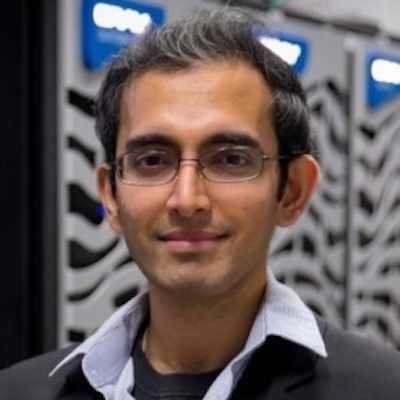
Das Pemmaraju is a Computational Physicist specializing in state-of-the-art quantum simulation software designed to model the dynamical properties of materials on high-performance computing architectures. He currently serves as a Quantum Computational Scientist in IBM’s Quantum Industry & Tech Services division, where he focuses on quantum chemistry, machine learning, and optimization problems to drive quantum transformation for clients.
Prior to joining IBM, Das held scientific research positions at SLAC National Accelerator Laboratory and Lawrence Berkeley National Laboratory, conducting research at the intersection of quantum materials, ultrafast spectroscopy, HPC, and data science. Over the course of his career, he has co-authored successful research grants securing over $7 million in funding, contributed to patented topological switching technology, and published over 70 peer-reviewed research articles—including more than 25 in high-impact journals such as Science, Nature, and Physical Review Letters. He holds a Ph.D. in Theoretical Physics from Trinity College Dublin and a Master’s degree in Theoretical Physics from the Indian Institute of Technology, Madras.

