By Hrishikesh Lakshman
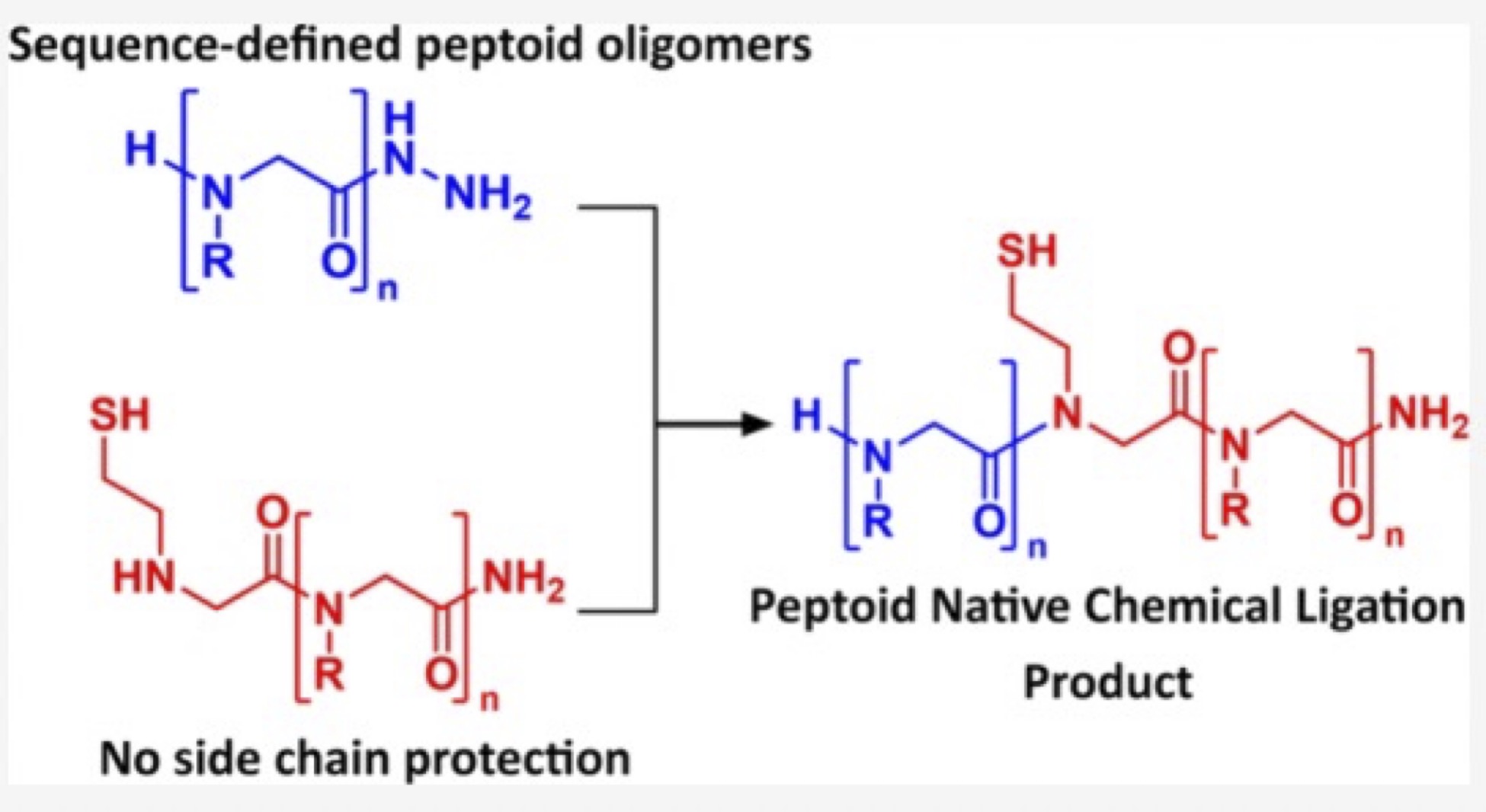
Making peptoids, synthetic analogs of proteins, is an exercise in patience. These sequence-defined molecules are assembled one unit at a time, by hand, over hours. Assembling six units is routine, ten makes a long day, and every added step is another chance for something to go slightly wrong. Over many steps, the losses accumulate until building long chains becomes impractical.
Sequence Length is crucial to expanding peptoid function. Proteins carry out much of the work inside living cells, and in recent years therapeutics built from peptides, their smaller chemical cousins, have grown rapidly . However, natural peptides often have a short lifetime in the body because enzymes find them quickly and break apart their backbone bonds. Peptoids resist this degradation because their backbone is slightly different, enough that enzymes don’t recognize it. The long-term goal is to build peptoids that fold into useful, protein-like structures, which requires synthesizing much longer chains.
Now, Matthew Seraydarian, a graduate student in Kent Kirshenbaum’s group at New York University, has found a way around that limit, working at the Foundry with scientific engineer Michael Connolly. Instead of building one long chain, the team builds two shorter ones and joins them head to tail, linking the end of one chain to the start of the next. The joining reaction runs in water and requires no harsh solvents or specialized equipment. Crucially, it leaves the backbone, the repeating chain of atoms that links the units together, exactly as it would be in a peptoid built from scratch. Earlier joining methods altered the backbone at the seam, which undercut the very structure that protects peptoids from enzymes. The result is a practical route to peptoids far longer than previously possible. The work was recently published in the journal Biochemistry.
Interested in Becoming a Foundry User?
Join our collaborative, multidisciplinary environment.
Learn more >
Head-to-tail joining of molecular chains, a process known as native chemical ligation, was first developed to make longer natural peptides. Peptides built by chemical synthesis face the same problem as peptoids: efficiency drops with every unit added, so long chains are hard to make in one piece. Ligation lets chemists build shorter fragments and join them. The approach has been applied to peptoids before, but earlier methods were either unreliable or altered the underlying backbone structure.
To prepare starting materials for the coupling reaction, the team utilized automated synthesis capabilities at the Foundry’s Biological Nanostructures facility. Its automated synthesizers produce chains of 14 to 20 units, lengths that are challenging and labor-intensive to make by hand, to serve as the building blocks for ligation.
Then the chemistry offered a surprise.
A product came back heavier than it should have been, with an added mass that did not correspond to known side products. Since the peptoid chain carried many identical side chains, Seraydarian assumed some minor change was happening at all of them at once. He chased that explanation for a while, but the numbers never cooperated.
The breakthrough came from Connolly, who posed the question: What if the change was not occurring everywhere, but in exactly one place: the N-terminus, where the chain begins?
To find out, Seraydarian deliberately went small. He made peptoids only three units long and ran them through the same step. Stripped of structural complexity, the short molecules revealed that when a particular kind of side chain sits at the first position, the activation step forms a different compound exclusively at the N-terminal unit.
Identifying the cause lets the team refine its design rules, so future sequences avoid placing that side chain at the starting position. The affected chains also still worked as intended. They assembled into nanosheets, flat two-dimensional structures that peptoids can form on their own, which served as a test of whether the joined chains behave like peptoids built from scratch. Nanosheets are also useful in their own right as platforms for sensing and molecular recognition, and longer chains open the door to more complex sheet designs.
Moving forward, the research team is evaluating how far the method can be pushed. “As long as you can keep purifying the product, you can go as long as you want,” Seraydarian said. Peptoids of 100 units, he believes, are within reach.
A follow-up study now underway at the Foundry is investigating whether the pieces can be treated as modular building blocks, mixing and matching short sequences to assemble libraries of long ones. If long chains cease to be a luxury, Seraydarian expects more researchers will begin designing peptoids that fold.“Maybe years, decades down the road,” he predicts, “this reaction will have been used to make some incredibly cool peptoid sequences and architectures.”

