The Molecular Foundry hosted its annual NanoArt competition in celebration of National Nano Day – 10/9 – which helps raise awareness of nanotechnology, how it is currently used in products that enrich our daily lives, and the challenges and opportunities it holds for the future.
We had a number of great entries from the Molecular Foundry community, and now the votes are in! The top entries will be professionally printed and displayed in the Molecular Foundry’s lobby.
1st Place
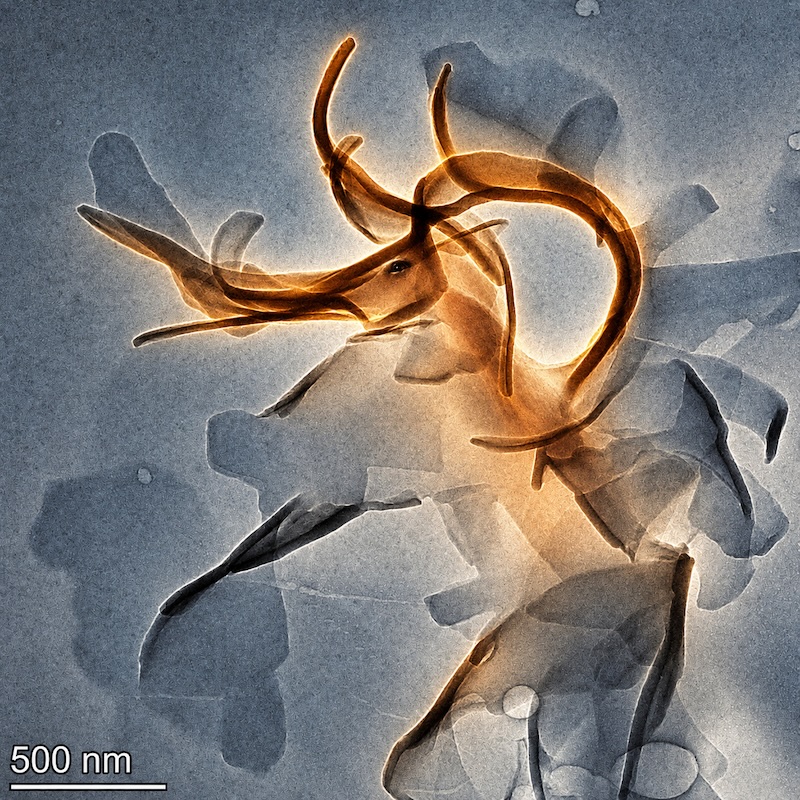
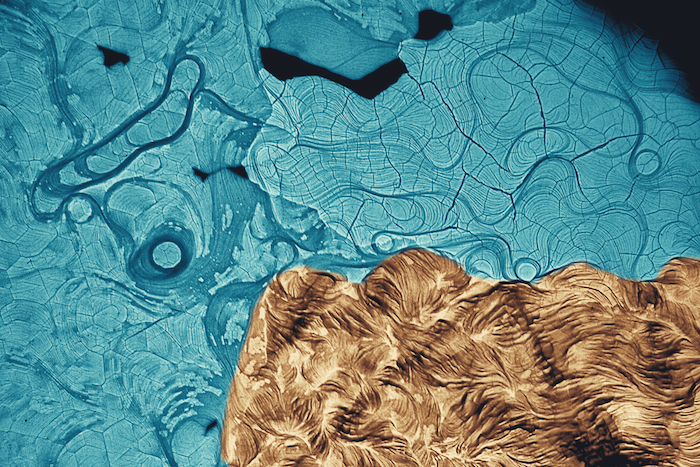
Submitted by Diyi (Dylan) Cheng from Berkeley Lab. “Golden Antler Deer.” A TEM image of a fractured polymer membrane featuring delicate, antler- and flower-like morphological structures. The polymer membrane serves as both a sample support and a thin, electron-transparent viewing window essential for achieving high spatial resolution at the nanoscale. It was imaged using an improved in situ electrochemical liquid cell platform on the THEMIS microscope at NCEM. It is designed to study real-time dynamic material behaviors in liquid environments during electrochemical reactions, such as electrocatalysis or battery processes.
2nd Place
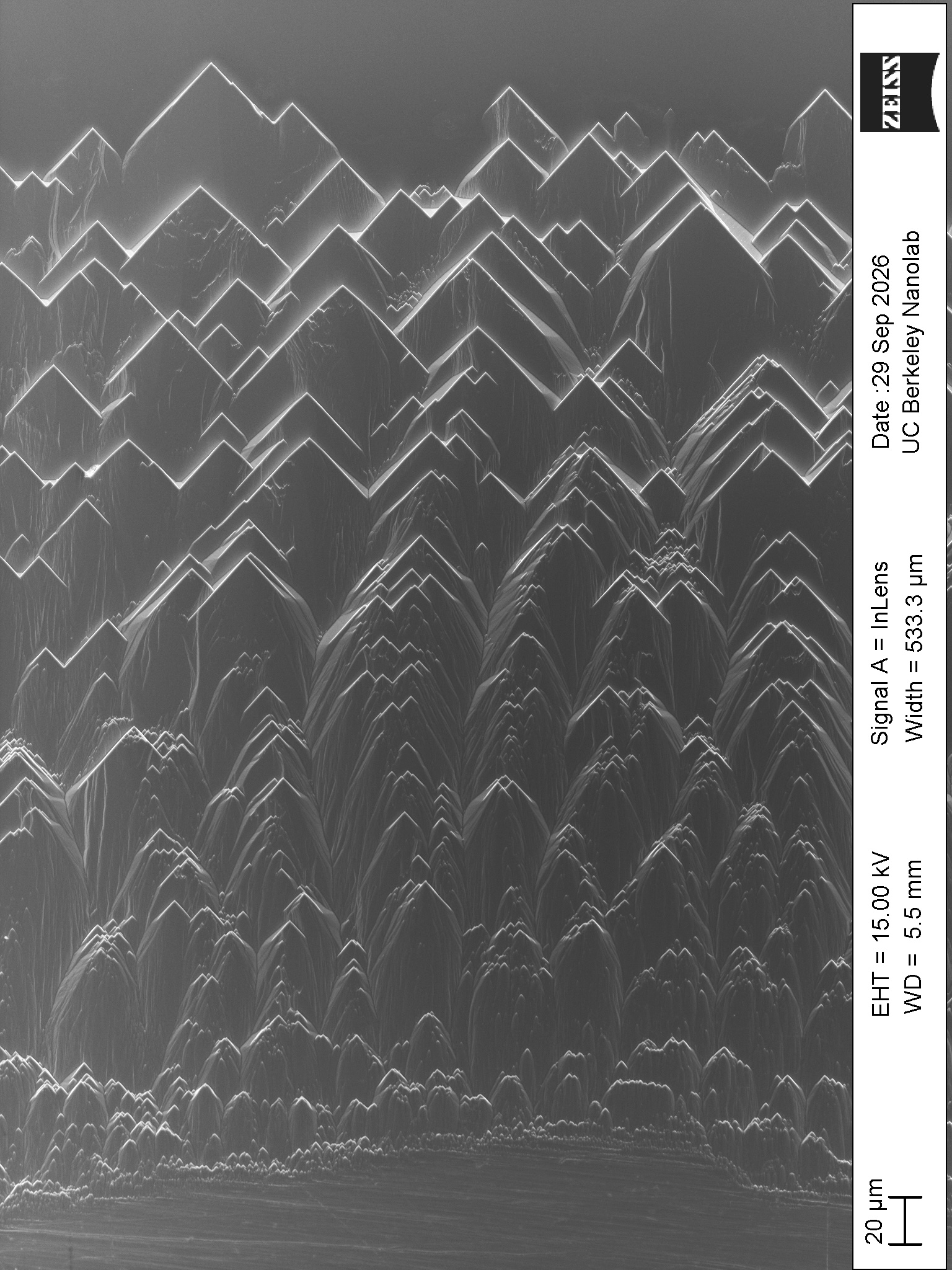
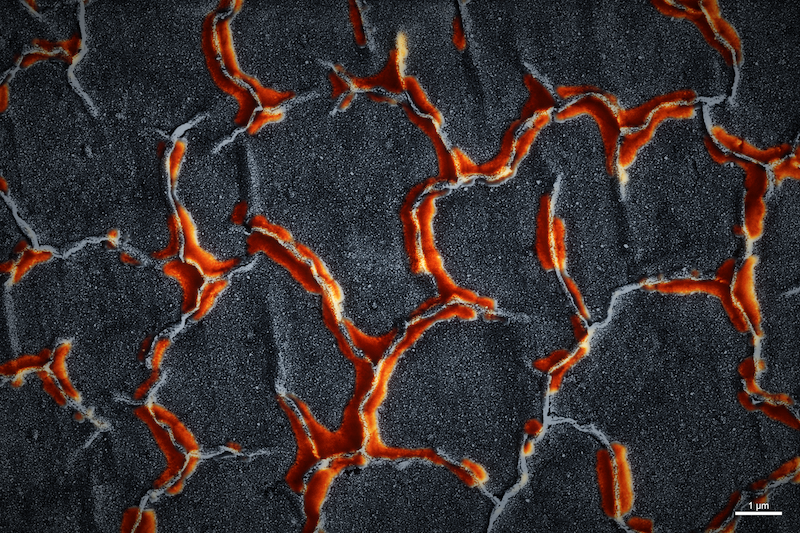
Submitted by Lory Marchand from UC Berkeley. A partially etched indium phosphide surface, shaped by hydrochloric acid into faceted features resembling a majestic mountain range. At the bottom, a protective layer of resist preserved a rough, flat surface like a tranquil lake. Above the mountains, the underlying InGaAsP layer, untouched by the acid, emerges as a dark and serene night sky. Combining III-V materials such as InGaAsP with silicon platforms is an important approach for building next-generation optical technologies. In this work, the bonded InGaAsP layer will be used to fabricate photonic crystal lasers, compact, high-performance light sources that could enable faster and more efficient optical communication and photonic devices.
3rd Place

Submitted by Wiebke Koepp from the ALS. Sometimes an algorithm goes too far. With one parameter set too high, a noise-removal step applied to X-ray scattering data turned sharp features into what looks like a painting with thick brushstrokes. The data comes from the very first thin-film sample in a campaign searching for new chip-manufacturing materials. The thin film was made at the Molecular Foundry using the AutoBot robot. The sample behind this image is a new photoresist candidate. Photoresists are light-sensitive coatings used in extreme-ultraviolet (EUV) lithography to pattern the smallest features in today’s computer chips. Combining automated synthesis, high-throughput characterization and machine learning helps the team understand how a material’s structure shapes its performance and find promising candidates faster. This image was part of work conducted by Wiebke Koepp and the 10k Sample Project Team across the Advanced Light Source, Molecular Foundry and Center for X-Ray Optics: Maher Alghalayini, Edward Barnard, Arian Gashi, Brett Helms, Alexander Hexemer, Tim Kodalle, Wiebke Koepp, Oleg Kostko, Declan McCarthy, Fabrice Roncoroni, Carolin Sutter-Fella, Morgan Wall, Yunfei Wang, Chenhui Zhu.
4th Place
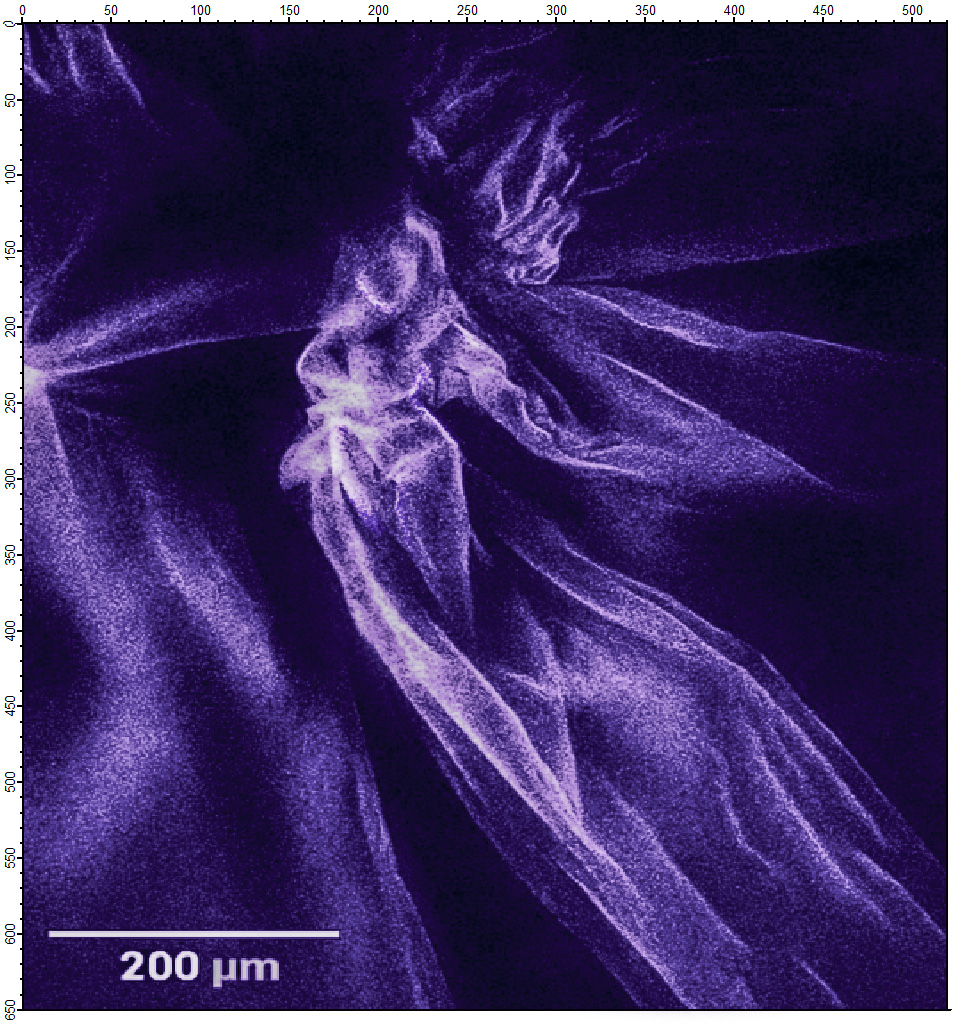
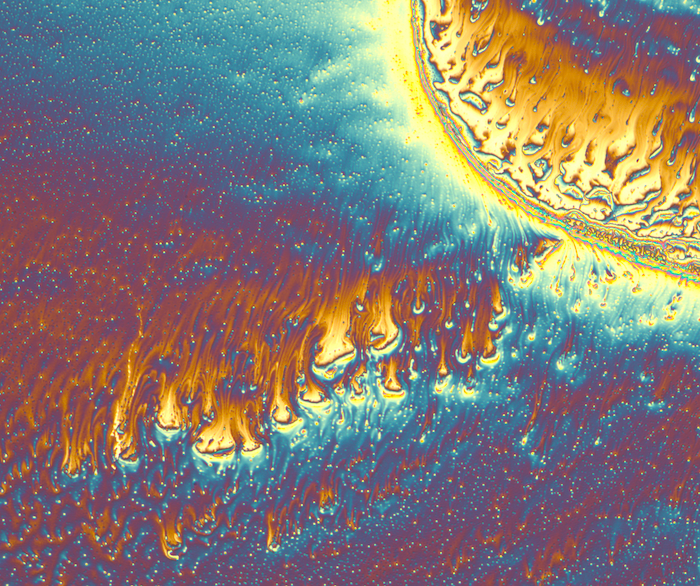
Submitted by Preetika Rastogi from the Molecular Foundry. The Water Dancer: The image shows a wrinkled solid film of Nanoparticle-Surfactants (NPS) wrapping a water drop inside a pool of oil. By introducing surfactants (small interfacially active molecules) and fluorescently labeled silica nanoparticles of complementary chemical functionality to the oil and aqueous phases, respectively, NPS form and assemble at the oil-water interface in-situ. As the water volume is reduced, the NPS assemblies pack closely and jam to form this solid film. The image intensity corresponds to the packing density of nanoparticles in the wrinkled film through the confocal slice. This image is reminiscent of a dancing lady in an elegant velvet dress and was acquired using a Laser Scanning Confocal Microscope (LSM 710) in the Biological Facility of The Molecular Foundry. Laser Scanning Confocal Microscopy enables time-resolved imaging of Nanoparticle-Surfactant (NPS) assemblies in-situ at the interface of two liquids, to describe the kinetics of adsorption and nanoparticle arrangements over large oil-water interfacial areas.
5th Place
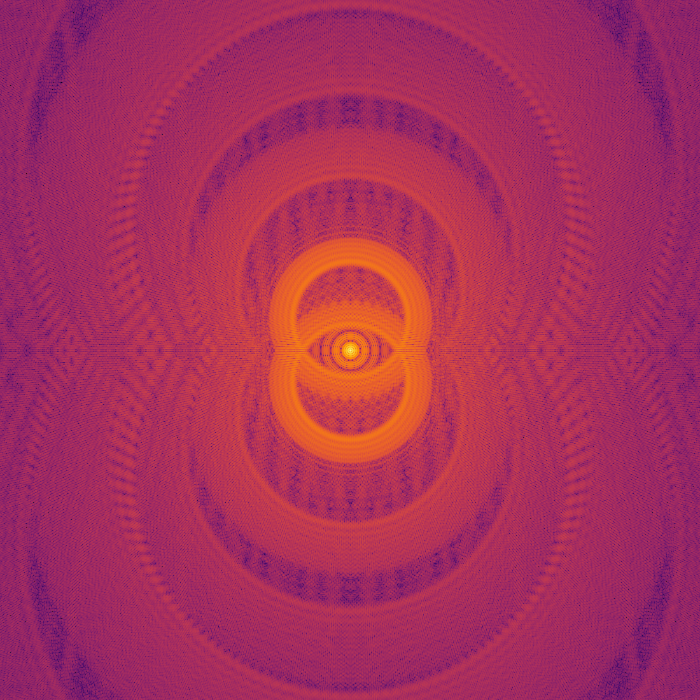
Submitted by Ryan Evanson (ALS). This is an example of structured light. Normally we consider light as a flat (plane) wave traveling through space. In this case using a novel optical element we can generate X-ray photons that consist of the combination of two overlapping beams that cork-screw through space carrying what is called orbital angular momentum. These beams can reveal similarly twisting details inside materials. We can build devices with materials components that can be polarized with magnetic or electric fields to generate nanoscale topological (twisted) objects called skyrmions. These so-called nano-hedgehogs may act as future information carriers in next generation microelectronics. The optical element that generates this beam rendering was fabricated using the Ebeam writer in the Nanofabrication Faciity at the Molecular Foundry. It generates an interference pattern of two overlapping twisted light beams that each turn 101 times in the visible plane. It was used in measurements at the Advanced Light Source and could form the basis for novel X-ray microscope capabilities at the ALS-U. Using X-ray beams with orbital angular momentum we can see intricate magnetic or electrical textures in materials that may be the future information carriers (bits) in low-power microelectronics. The image was produced as part of work by Ryan Evenson (ALS), Dayne Sasaki (EUVtech), Sujoy Roy (ALS), David Prendergast (TMF).
6th Place
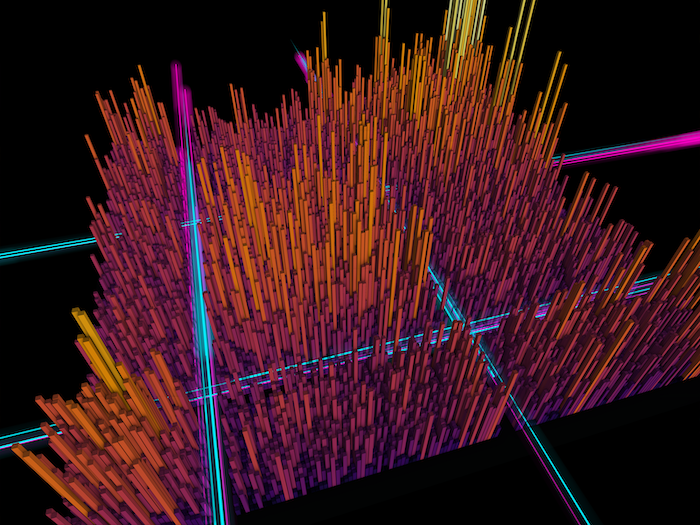
Submitted by Yi-Ru Liu from the Molecular Foundry. A city at dawn, built from a machine-learning model of materials. Each pillar’s height shows how strongly two data points are related, while glowing streets divide different materials into city blocks. By predicting which conditions are most promising, this technique can help scientists choose the most informative experiments instead of testing every possibility. That could speed up the discovery and improvement for better materials.
Honorable Mentions