By Anthony Jin
As batteries power a significant component of our everyday lives, from transportation to home appliances, understanding how their materials work is increasingly important. Researchers today are still seeking to understand the details of how battery materials actually charge and discharge at the atomic level. A team at the Foundry has recently developed a new model to better understand this core process. Their findings, recently published in the journal Nature Communications, provide a reimagined picture of how ions move through defect-prone materials, which may pave the way for designing more efficient batteries.
To investigate battery discharge, the team focused on graphite, a material widely used in battery anodes. Graphite, which consists of crystalline carbon and has useful properties such as high conductivity, is the host for the core mechanism behind batteries – a process known as intercalation, the movement of charged ions through a battery during the charge-discharge cycle. Since it governs charge transport and storage, intercalation directly dictates overall battery performance. Despite graphite’s widespread use, “a true understanding of intercalation into graphite interlayers is still lacking,” explained Andrew Minor, the lead investigator and Facility Director of the Foundry’s National Center for Electron Microscopy. To help close that gap, Minor and lead author Peter Schweizer, who was a postdoctoral researcher at the time, set out to uncover how defects in the host graphite altered the intercalation of ionic species.
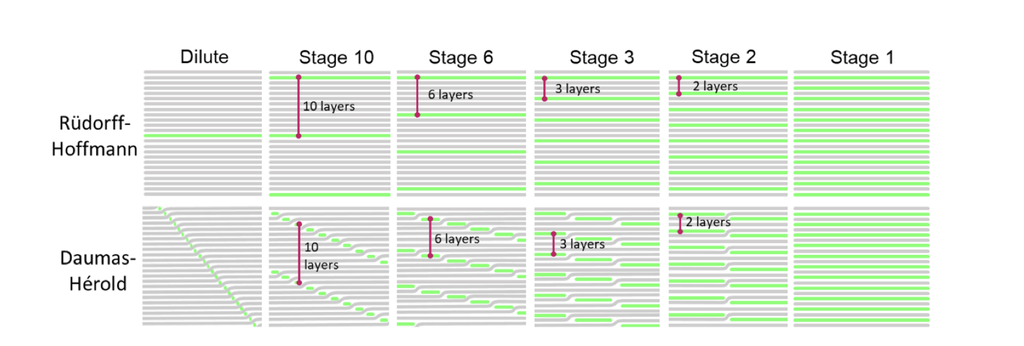
The researchers re-evaluated two of the existing models of intercalation, shown below. While these models roughly depict ion movement within the host material, they do not account for the inevitable presence of material defects and their impacts on the transfer of charge in a battery. The core gap in knowledge lies in the progression of ion layers between the beginning and end of the model. Both existing models (shown below) present layer insertion behavior that is not physically plausible, such as layers moving laterally during the intercalation process.
To build a model that reflects the real world, the research team tracked the graphite structure during intercalation in real time using four-dimensional scanning transmission electron microscopy (4D-STEM) during in situ heating. In conventional scanning transmission electron microscopy (STEM), an electron beam scans across a sample, and a detector counts scattered electrons to form an image. In 4D-STEM, a high-speed camera records a complete two-dimensional diffraction pattern at every point in the scan grid, yielding a four-dimensional dataset. Schweizer states, “It’s a general microscopy technique, but in 4D-STEM you can apply it in a new way, where you can select the diffracted electrons after the experiment.” This enables researchers to construct multiple visualizations of the battery’s different material layers simultaneously. The scientists leveraged the resulting structural information to overlay local crystal structure, defects (dislocations), and inserted ion layers to identify any correlations between the material properties.
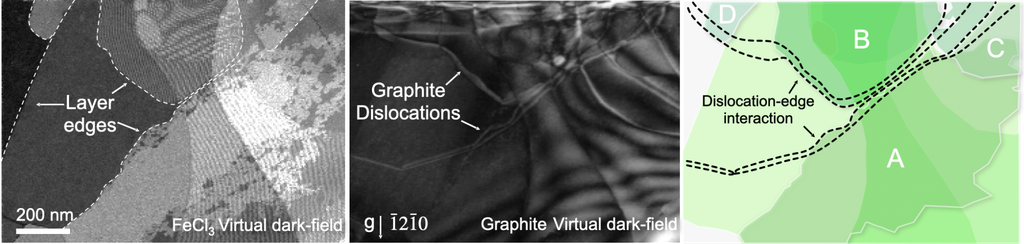
Previously, researchers could only look at one imaging condition at a time, viewing either the host material or the inserted ions. Schweizer emphasized, “That’s the beauty of 4D-STEM: we acquire everything, and then we can choose afterwards what we want to look at.” By analyzing the material defects within the host lattice and their corresponding interactions with ion insertion, the research team was able to deduce a measurable relationship between lattice defects and intercalation behavior.
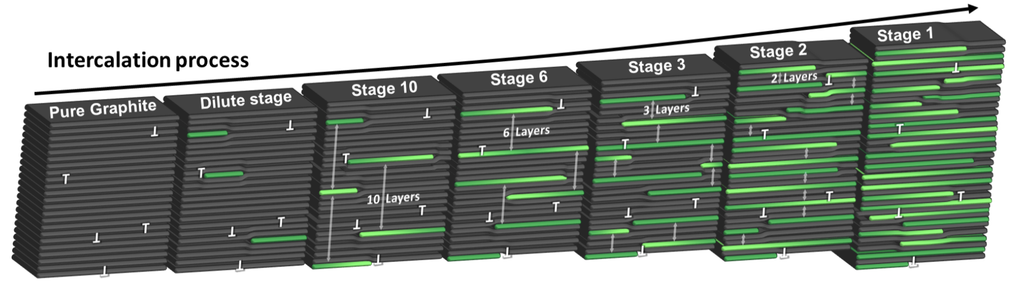
The research team proposed a ‘stochastic simultaneous intercalation model’, where ion injection into the host lattice is more random than previous models have assumed. The new model presents a classification that can account for the impact of defects on the performance of a battery. “By visualizing the way ions interact with defects, you see that the defects can actually give you different staging models throughout the material,” Minor emphasized.
Beyond its immediate insights into graphite anodes, the study serves as a proof-of-concept for real-time, multi-modal characterization of energy materials. “You no longer need to make a compromise between how many things you can visualize and how detailed the visualization is,” said Minor.
Interested in Becoming a Foundry User?
Join our collaborative, multidisciplinary environment.
Learn more >
As batteries take on a greater role in transportation, consumer electronics, and energy storage, improving their performance requires a deeper understanding of the materials inside them. By eliminating the traditional limitation of a single imaging condition, this real-time imaging approach opens new opportunities to investigate how imperfections influence energy-storage materials. The continued refinement of 4D-STEM techniques lays the groundwork for designing more efficient battery materials – facilitating better batteries to support growing energy-storage needs.

