By Claire Tsai
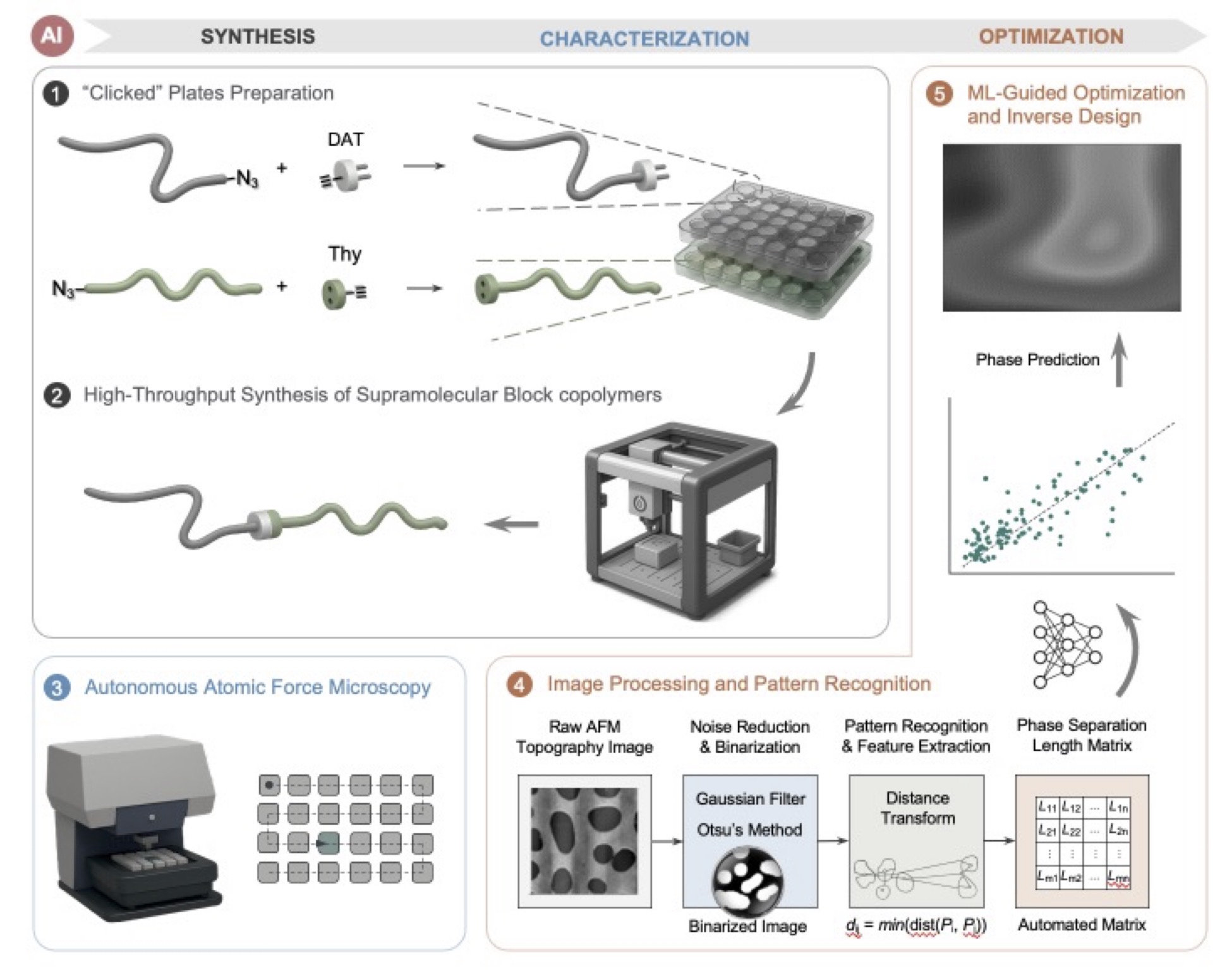
From durable plastics to electronic coatings, everyday materials depend on an unseen process: how polymer blends separate into nanoscale regions. This dictates how a material bends, breaks, and functions. But similar to oil and water, polymers do not always mix homogeneously, and can instead separate into distinct regions as they cool, dry, or are processed. This separation, or domain spacing, is what gives these materials their shape and properties. For decades, material scientists have relied on a complex and slow process of combining polymers and then carefully tuning how they separate into microscopic domains to achieve the right formulation for these polymer blends. Recently at the Molecular Foundry, scientists have discovered a new way to make this process more efficient. This new high-throughput workflow combines modular polymer synthesis, robotic formulation, automated atomic force microscopy, image analysis, and machine learning, allowing the researchers to rapidly map how chemical design and processing conditions can shape a material’s final structure, and use that data to guide the formulation of new polymers.
Unlike conventional polymers that are permanently linked together by covalent bonds, the researchers focused on supramolecular polymer blends (SPBs), which can be assembled through reversible noncovalent interactions. The reversible nature of SPBs makes them especially useful for rapid design as the researchers can prepare the polymer components separately and then pair them to form blends with different combinations. “It’s like building LEGO rods. We made all these Lego blocks, and if we kind of snap them together, we can create a longer yet unique block” Xiaodan Gu, an associate professor of Polymer Science and Engineering at The University of Southern Mississippi, elucidates.
The discovery began with the synthesis of 33 homopolymer precursors. The researchers then used click chemistry, a highly efficient chemical reaction, to join molecules together and attach hydrogen-bonding groups to polymer chains. Then, a liquid-handling robot was used to pair the complementary polymers in solution. This strategy produced around 260 supramolecular polymer blends in a single day. “You can ask the robot to say, ‘I need this amount of A and this amount of B,’ and then just mix them. So you can go through an array or a matrix of different mixtures very quickly.” Yi Liu, the Facility Director of Organic and Macromolecular Synthesis at the Foundry describes. After synthesis, the team characterized these new blends using automated atomic force microscopy (AFM), a technique that scans a tiny probe across a surface to map nanoscale features. It was this approach that allowed the researchers to visualize the domain spacing as each blend was created.
Interested in Becoming a Foundry User?
Join our collaborative, multidisciplinary environment.
Learn more >
For postdoctoral researcher Yunfei Wang, the Molecular Foundry’s interdisciplinary setting was critical to making this discovery possible. “The Foundry provided a perfect platform to enable that, because they have expertise spanning from material creation, advanced characterization, and even theory,” Wang said. When Wang and Gu ran into a bottleneck with the time-consuming nature of the AFM, Liu helped them find a way to streamline the process. “I introduced them to Paul, a staff scientist at the Biological Nanostructures Facility, who was able to help them establish high-throughput AFM. It really helped them solve the characterization bottleneck,” Liu says. Automating the characterization process allowed the researchers to map sample positions, acquire optical images, and scan samples quickly. “We increased the throughput by a factor of 10 or 20, in terms of how fast we can measure the sample.” Gu highlights. The automated workflow could accommodate up to 52 samples at once, although researchers exchanged samples between runs. Wang explains, “We measured nine images per sample across 260 samples, so, in total, we obtained 2,340 images that can be finished within one week.”
Once the team measured the domain-spacing for the SPBs, professor Boran Ma at University of Southern Mississippi trained several machine learning models to connect polymer molecular weights with the observed morphology. The researchers also tested whether this predictive model could work in reverse, and were successfully able to target domain spacings of 50, 100, and 150 nanometers. “If we can control the size and create a bicontinuous pathway, we can create some unique materials with combined properties,” Gu explains. This improved control over phase separation may help researchers design solid-state battery electrolytes, develop strategies for recycled plastics, or even streamline nanolithography. Their work, supported by the Department of Energy’s Synthesis and Processing Science program, was recently published in Jacs Au.
Looking towards the future, the researchers are now interested in streamlining this process and extending this strategy to other supramolecular interactions and polymer architectures. “We envision a smart robot making the sample, then passing it to the x-ray system for characterization, and using AI to tell us what is the new formulation to optimize for the next iteration,” Gu exemplifies. But for now, the study offers a working model of a new research rhythm: building materials, automatically characterizing them, and then using the resulting data to make predictions on how to optimize the blends. In a field where polymer design has often depended on slow cycles of synthesis and trial-and-error, that shift could make materials discovery faster, more systematic, and more responsive to real-world needs.

