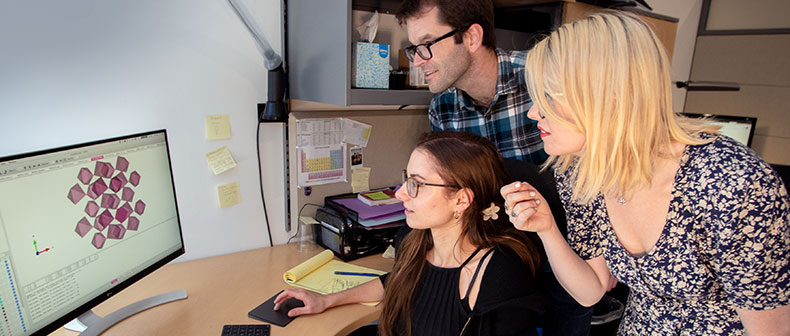
The Data Automation Theory and Modeling facility unites predictive computational science with advanced digital infrastructure to accelerate materials discovery at the Molecular Foundry. By bridging fundamental theory, automated workflows, and data-driven methods, we support the entire life cycle of scientific data—from synthesis and sample processing metadata through to analysis, modeling, and open sharing.
Our facility advances nanoscale science by linking structural and dynamical properties to function across critical applications, including energy generation and sensing, molecular self-assembly, gas separation, and information processing. We develop and deploy a comprehensive suite of computational and data tools:
- Theory & Modeling: Advanced electronic-structure theory, excited-state methods, model Hamiltonians, statistical mechanics, and materials analytics.
- Automated Infrastructure: Custom software pipelines, automated synthesis/fabrication integration, and user computing support.
- FAIR Data Architecture: Systems for Findable, Accessible, Interoperable, and Reusable data storage, automated analysis, and domain-specific workflow optimization.
By combining first-principles theoretical understanding with machine learning, automated equipment integration, and robust data pipelines, our team collaborates directly with staff and users to translate complex scientific requirements into actionable technologies that meet global energy and information challenges.
Highlighted Research Programs
Energy Management in Complex Materials
Interactions at the nanoscale govern the interconversion between electronic, optical, magnetic, and phononic modes in complex materials. Employing leading-edge electronic structure methods, the atomic-level details of energy storage and transfer in these forms are explored. The insight gained enables fine-grained control over the types and rates of these processes in nanoscale electronics, light-harvesting, carbon capture, and thermoelectric applications.

Materials for Quantum Information Management
Communication, decoherence, and entanglement in quantum information systems are explored by atomistic simulations of mechanisms responsible for these processes. These insights are used to correlate structure to qualities favorable to quantum information management, such as coherence and ease of selective entanglement formation. This will inform materials design strategies for realizing a growing set of electronic topologies, and harnessing them to protect the fidelity of quantum information.
Computational Spectroscopy
The response of complex materials over the near IR to the X-ray spectral ranges can be predicted and interpreted through a combined first-principles electronic structure and molecular dynamics approach, revealing atomic-level details of charge, bonding and dynamics. XAS, Raman, nonlinear optical, and pump-probe simulations have revealed spectral features that are sensitive to dynamical degrees of freedom and local electronic structure, which guide the design of new experiments and materials for energy and information functionality.

Pattern Formation at the Nanoscale
We explore the self-assembly and self-organization of molecules and nanoparticles, whether passive, driven, or active, by combining quantum mechanically-derived interaction parameters with statistical mechanical modeling. This multiscale approach, carried out in collaboration with Foundry staff and users, allows us to explore equilibrium and nonequilibrium nanoscale materials made in the laboratory. Our overarching goal is to identify principles and design rules for the bottom-up control of matter at the molecular scale.

ScopeFoundry
ScopeFoundry is a Python platform for controlling custom laboratory experiments and visualizing scientific data developed at the Molecular Foundry. ScopeFoundry is currently used on a dozen microscopes and synthesis systems at the Foundry. Additionally ~10 groups are actively using ScopeFoundry to run their labs around LBNL and at academic institutions around the world. This unique capability of quickly iterating on custom instruments has allowed us to rapidly react to users’ needs. An example of this is laser annealing of microwave qubits from Irfan Siddiqi. Their group identified work at IBM that showed that laser annealing of qubit junctions may act as a tuning mechanism for junction resonance frequencies. Over the course of a week, we modified a ScopeFoundry microscope and built custom software to perform high throughput automated annealing of a wafer full of these qubits. This allowed their group to quickly identify optimal annealing conditions.

ML-enabled Autonomous Synthesis Workflows
Foundry scientists have recently demonstrated the ability of neural networks to learn time-dependent protocols for materials self-assembly and synthesis. This approach, based on a branch of machine learning called reinforcement learning, focuses on real-time control of instruments and is distinct from approaches that attempt to identify promising initial conditions for synthesis. We are currently implementing these algorithms into autonomous materials discovery workflows on several robotic synthesis systems, including liquid- and gas-phase synthesis tools. The result will allow autonomous experiments in which a user specifies an objective and the learning algorithm performs multiple syntheses, iteratively improving its time-dependent protocol, until the objective is attained.
Correlation Microscopy Workflows
Developing next-generation materials requires a deep understanding of structure-property relationships at many length scales. This in-turn necessitates the ability to acquire and cross-correlate data acquired through a range of microscopy and spectroscopy techniques in a high throughput manner. We are developing a universal platform that allows users to send a single sample to different characterization laboratories throughout the Foundry and ultimately acquire a cross-correlated data set that can produce novel structure-property insights.


