Interest in electron microscopy (EM) at low temperatures has grown steadily over the decades. Forty years of development in cryoEM for biology culminated in the 2017 Nobel Prize for the technique, and corresponding interest in the physical sciences has become much stronger recently with the focus on quantum information systems.
Similarly, the technology of EM has steadily improved, with advances in spatial resolution (due to aberration correction), energy resolution (due to improved electron sources), temporal resolution (a variety of methods), and signal-to-noise (due to direct electron detectors). Still, EMs lack the stability and low temperature capabilities of their 2-dimensional counterparts (e.g. scanning tunneling microscopes). Overcoming those limitations would allow us to explore the defects, interfaces, phase transformations and emergent behaviors that impact novel quantum materials—key to future technologies such as QIS – at atomic resolution in 3 dimensional structures.
60 years of attempts to make part of the microscope cold have not surmounted the impediments posed by a room temperature microscope. Making the entire microscope cold (and superconducting) will eliminate thermal drift, shield electromagnetic interference, and enable 3D atomic resolution imaging at a range of sample temperatures – down to those of quantum phenomena.
Berkeley Lab researchers have already achieved key proof-of-concept demonstrations, including establishing constant magnetic field persistent current operation in a prototype lens using novel tuning and stabilization methods, achieving record energy resolution from a niobium emitter, and showing that superconducting shielding reduces magnetic interference by a factor of 1 million.
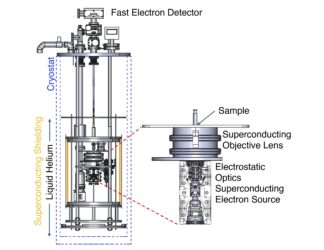
The stability that an all-superconducting microscope can offer (~nm/day vs. ~nm/sec drift) can only be verified by building such a microscope. A prototype 5 keV all-superconducting microscope is now being constructed, with the goal of demonstrating the ultimate performance an all-superconducting microscope could achieve.
Since such a microscope has never been built before, we are undertaking the critical R&D essential to establishing the proof of concept and feasibility. After that, what remains are engineering challenges – not insignificant – but which have been addressed either in commercial electron microscopes, or in the superconducting RF accelerator community. A brand new microscope affords the opportunity to fully integrate AI into the platform.
Building the Metrology of our Quantum Future

Download the brochure that summarizes our vision for an entirely cold, superconducting electron microscope.
Past News & Workshops
2025 Report – Workshop on Realizing the Potential for Low Temperature Electron Microscopy
2023 Article – Excerpt from Berkeley Lab article on tool development
2022 Article – To Make a Better Electron Microscope, Go Straight to the Electron Source
2019 Article – Going Cold – The Future of Electron Microscopy
2019 Paper – Cryogenic electron microscopy for quantum science
2019 1K TEM Workshop
2016 Workshop Focuses in on Electron Microscopy

