Scientific Achievement
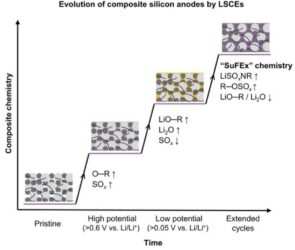
This paper uses “electrode-omics” (XPS-based chemical profiling) to show how mixed-salt ethereal electrolytes create resilient, crack-resistant silicon battery anode coatings.
Significance and Impact
This approach could enable longer-lasting, higher-energy silicon-anode lithium batteries for EVs and electronics by guiding smarter electrolyte design that prevents mechanical degradation.
Research Details
- Drawing from evolutionary biology’s theory of punctuated equilibrium, XPS-based “electrode-omics” quantified evolving chemical species (LiO–R, Li₂O, SOx) in silicon anode composites across cycling, finding distinct “evolutionary bursts” in SEI chemistry.
- Mixed-salt LSCE electrolyte (LiFSI:LiClO₄:DME:TTE) prevented silicon anode cracking via SuFEx chemistry, unlike carbonate electrolytes, confirmed through FIB-SEM imaging and nanoindentation testing.
- Full-cell cycling tests showed Si|NMC811 cells retained 79.8% capacity after 100 cycles with mixed-salt LSCE, versus only 31.2% with conventional carbonate electrolyte.
Ko, Y., Kim, D-M., Muscgrove, A.L., Cha, H., Klivansky, L., Coyle, J., Dopilka, A., Trask, S.E., Rodrigues, M.F., Byeon, Y-W., Kim, H., Kostecki, R., Veith, G.M., Helms, B.A., Sci. Adv. 12, 23 (2026) DOI: 10.1126/sciadv.adx0930
Research Summary
Silicon is an attractive anode material for lithium-ion batteries because it can store far more lithium than conventional graphite, promising higher energy density. However, silicon anodes swell dramatically during charging, which cracks the composite electrode and causes rapid capacity loss which is a major barrier to commercialization.
This study introduces “electrode-omics,” an analytical framework borrowed from biological omics approaches, to systematically track the chemical evolution of silicon anode composites over their operating lifetime using x-ray photoelectron spectroscopy (XPS). The researchers found that a specially designed ethereal mixed-salt electrolyte by combining lithium bis(fluorosulfonyl)imide and lithium perchlorate and found that it triggers sequential “evolutionary bursts” of chemical species within the electrode, analogous to punctuated equilibrium in evolutionary biology. Early cycling produces lithium alkoxides and lithium oxide, while extended cycling regenerates sulfur-oxide species through a previously unrecognized type of “SuFEx” click chemistry between electrochemically generated oxoanions and electrolyte anions.
This chemical evolution produces a mechanically resilient composite that resists cracking, in stark contrast to conventional carbonate electrolytes, which form rigid, brittle lithium carbonate and fracture severely. The mixed-salt electrolyte simultaneously stabilized high-voltage cathodes, enabling full silicon-nickel-rich cathode cells to retain ~80% capacity after 100 cycles with minimal overpotential increase, and scaled successfully to practical pouch cell formats, demonstrating a promising path toward durable, high-energy silicon-based batteries.

