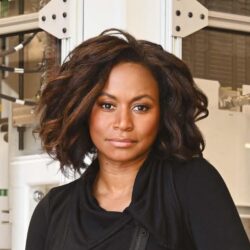
By Kristopher Benke
Etosha Cave is the Chief Scientific Officer at Twelve, a company she co-founded with the goal of converting CO2 into useful products like jet fuel. The company name is inspired by carbon-12, the most common isotope of carbon, the atom at the center of all the molecules they make. Etosha came to the Foundry to better understand their core technology–once a postage stamp-sized electrode, which they have now scaled up to tackle CO2 conversion at commercial scale.
Tell me more about your company Twelve and what you do.
At Twelve, our focus is on using CO2, electrical energy, and water to produce hydrocarbons that can replace fossil-derived ones. Sustainable aviation fuel is the first molecule we’re scaling commercially, but the underlying chemistry enables us to produce a broader range of hydrocarbon blends as well in order to provide a domestic source and more diverse supply chain for hydrocarbon production outside of strictly petroleum.
Can you tell me a little more about your work developing hydrocarbon blends?
Those blends can serve as intermediates for a variety of products, from fuels to chemicals and materials used in everyday supply chains. The goal is to create drop-in replacements that fit into existing infrastructure, whether that’s aviation, shipping, or industrial manufacturing. Depending on the application, the end customer could range from transportation companies to consumer brands that are looking to source domestic fuels and materials within their supply chains.
Let’s go back further. How did you first start your company and how have you spent your time at the Foundry?
Right after grad school, I got into a program called Cyclotron Road, where we were introduced to the Molecular Foundry. It provided a way for us to do the characterization that we needed to scale the technology. For instance, we could utilize microscopy and other detection mechanisms like the ICPMS, which could tell us if we had impurities and what their concentrations were in parts per million, like different types of ions in our system.
That was super helpful because if we had to buy that as a company, it would have cost us millions of dollars, and we just didn’t have that. We also did partnerships with Lawrence Livermore, and we published papers on that work. For our piece of the work, we were able to leverage our time at the Foundry to characterize those materials.
How much did you scale up your technology during your time at the Foundry?
Our core technology is the electrode, and we went from an electrode that was the size of a postage stamp to something the size of a desktop monitor. We did that in four steps over five or six years, from the size of a postage stamp, to an iPhone, to half a sheet of paper, and finally up to the size of a desktop monitor.
Each step along the way, we were building our electrodes and characterizing them and the output of the reaction that we were running.Every step along the way, we could leverage the Foundry.
As you scaled up the electrode, how did the way you used the resources at the Foundry change? What questions did you want to answer?
One of the core challenges in electrochemical technologies is scaling from small, highly controlled lab experiments to larger systems that operate reliably at commercial scale. When you increase electrode size, factors like current distribution, mass transport, and durability need to be optimized.
As we scaled up, our approach to characterization needed to evolve as well. In the early stages, we focused on measurements in a lab environment, but as systems grew, we needed to understand how those materials behaved in more realistic operating environments. The resources and instrumentation at the Foundry were extremely valuable for that transition, allowing us to test and analyze materials in ways that helped bridge the gap between fundamental research and practical engineering.
The Foundry was able to give us the space and the solvents to make our first inks to make those postage-sized electrodes, and as we moved on, we focused more on characterization. We were asking questions like, “What does it look like under a microscope?” We also used X-ray diffraction to see the crystal structure of the metals on our electrode, and ICPMS to understand if we had any metals that were leeching out into our electrolyte.
Next, we used the chemistry lab to make novel catalysts for our next generation system. When you’re developing technology, some part of it is just intuition. You’re saying “I understand the system. I’m making these hypotheses and testing them.” But i to make newer hypotheses, characterization data can be really helpful and getting equipment like a scanning electron microscope or an x-ray diffractometer to characterize samples is expensive. The Foundry was there to answer those “what if” questions along the way.
Interested in Becoming a Foundry User?
Join our collaborative, multidisciplinary environment.
Learn more >
How has your company grown along the way?
The Foundry played an important role in helping us translate fundamental science into something that could be engineered and scaled. Having access to world-class instrumentation and expertise allowed us to better understand how our catalysts and materials behave, which helped strengthen the technical foundation of our work.
That kind of validation is important when you’re building a company around a new technology. It helped us demonstrate the feasibility of our approach to partners, investors, and customers, which ultimately supported our ability to grow the company, expand the team, and move toward commercial deployment.
What’s next for your company? What challenge are you hoping to tackle next?
Our biggest focus at Twelve has been opening our first commercial plant in Moses Lake, Washington, which took place in early June. We hosted our ribbon cutting with our partners, Microsoft and Alaska, respectively. The opening of AirPlant One marks a major step toward producing synthetic aviation fuel from CO2 at commercial scale. More broadly, we’re working to expand the production of e-fuels and other materials made from domestic industrial biological carbon. The challenge—and the opportunity—is building the infrastructure and partnerships needed to move from promising technology to a truly global industry. If we can do that, we have the potential to significantly reduce emissions across major sectors, like aviation, shipping, and heavy transportation.

