Scientific Achievement
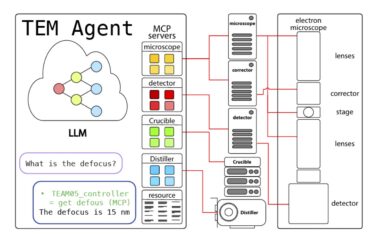
TEM Agent uses the Model Context Protocol (MCP) to provide a centralized orchestrator and natural language-based user interface for microscope control and database access.
Significance and Impact
This framework could democratize complex microscopy for non-experts, boosting throughput at shared research facilities and accelerating nanoscience discoveries through automation.
Research Details
- MCP architecture connected Claude Sonnet 4.5 to four custom and independent servers for controlling microscope hardware, detectors, and two data-management platforms simultaneously.
- Automated tomography workflows chained tedious multi-step tasks (tilting, focusing, imaging) together, executing high-quality tilt-series experiments with minimal human supervision or errors.
- Integration with the Crucible and Distiller databases enabled the agent to query historical metadata to apply optimized parameters for complex experiments, as well as automatically annotate and upload the resulting dataset.
Wall, M.K., Pattison, A.J., Barnard, E.S., Ribet, S.M., Ercius, P., npj Comp. Mat. (2026) DOI: 10.1038/s41524-026-02103-z
Research Summary
Transmission electron microscopy (TEM) delivers powerful nano- to atomic-scale imaging, but operating modern instruments requires navigating a complex ecosystem of vendor-specific software, detectors, correctors, and data platforms, posing a steep learning curve, especially at shared user facilities serving researchers of varying expertise.
This paper introduces TEM Agent, a framework that connects a commercial large language model (Claude Sonnet 4.5) to laboratory hardware and software through the Model Context Protocol (MCP). Rather than requiring specialized machine-learning training, TEM Agent uses simplified “tools” and “resources” to let the LLM query instrument states, execute predefined actions, and chain them into complex workflows via natural-language commands. The system integrates four MCP servers: one for core microscope control (including automated aberration correction), one for detector operation, and two for accessing experimental metadata databases (Crucible and Distiller).
The researchers demonstrate TEM Agent successfully automating tedious tomography tilt-series acquisitions, interpreting image statistics to find optimal focus, and leveraging historical experimental metadata to guide new data collection, including calculating optimal defocus and step-size parameters for ptychography experiments that produced a high-quality gold nanoparticle reconstruction. The framework prioritizes safety by constraining the LLM to pre-defined tools rather than letting it write code, while acknowledging current limitations in workflow determinism and image interpretation.

