Seminar Date: Tuesday, February 17, 2026
Time: 11:00 AM PT
Location: 67-3111 & Zoom
Talk Title: Anisotropic dipole-dipole interaction of NV centers in diamond
Zoom recording (available for 30 days)
Add this event to your calendar
Abstract:
Self-aligned, quasi-one-dimensional (quasi-1D) chains of coupled NV centers, with lengths on the order of tens of microns, can be created by swift heavy-ion irradiation of single-crystal diamond. Such chains offer a promising near-term platform for quantum information processing. Precise control of dipole–dipole coupling within these spin chains is essential for realizing logical qubit operations. When NV centers are brought into close proximity, magnetic dipole–dipole interactions can substantially modify their zero-field splitting (ZFS) and optically detected magnetic resonance (ODMR) signatures, with direct implications for spin-based sensing and quantum information protocols.
In this work, we combine spin-polarized density functional theory (DFT) with analytical dipolar models to quantify the coupling between two NV centers in diamond aligned along the [001] direction. By analyzing the residual dipolar tensor ΔD, we find that a head-to-head NV configuration leads to significantly stronger interactions than other orientations. For large separations and other displacement angles, we use truncated real-space wavefunctions to compute the dipolar interaction. The maximum interaction strength is 0.27 MHz at a separation of 6 nm, in good agreement with recent experimental measurements. Finally, we construct a symmetric, traceless rank-2 tensor model to parametrize the anisotropic dipolar coupling and to predict “magic-angle” directions of an external magnetic field that suppress dipole–dipole interactions. These results provide new insight into dipolar interactions in 1D NV chains and inform the design of solid-state spin architectures for quantum technologies.
Bio:
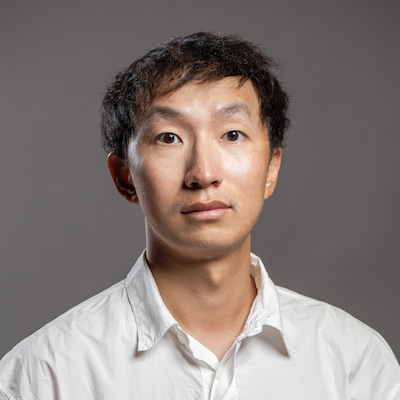
Guangzhao Chen is a postdoctoral researcher in the Accelerator Technology & Applied Physics Division. His research focuses on simulating the properties of color centers to optimize quantum defects for next-generation quantum applications.

