Seminar Date: Tuesday, April 21, 2026
Time: 11:00 AM PT
Location: 67-3111 & Zoom
Talk Title: Science Without Boundaries: Bridging Atomic Theory and Industrial Reality with Compute, AI, and Experiment
Zoom link
Add this event to your calendar
Abstract:
The Multiscale Challenge in Materials Science
Materials discovery and deployment routinely stalls in the gap between atomic-scale theory and real-world performance. We understand the quantum mechanics of bonding. We can characterize nanostructures with exquisite resolution. Yet translating those insights into reliable, manufacturable materials still depends heavily on empirical trial and error. This talk presents a methodology for closing that gap by coupling physics-informed AI, multiscale modeling, and autonomous experimentation into an integrated discovery loop that moves seamlessly from angstroms to meters.
Agent-Based Models Meet Agentic AI
The biggest breakthroughs in materials science happen at the interfaces: between disciplines, between scales, between theory and experiment. The next wave of physics-informed computing treats complex systems as collections of interacting agents, each carrying local physics, letting emergent behavior arise naturally rather than being prescribed top-down. In multiphase reactors, bubbles and clusters become autonomous agents whose collective dynamics reproduce plant-scale phenomena without brute-force resolution of every particle. The same philosophy applies across materials systems: polymer crystallization as interacting chain agents, catalytic surface reactions as adsorption-desorption agents, battery degradation as defect-interaction agents, and nanomaterial self-assembly as geometry-driven interaction agents. When these agent-based models are coupled with agentic AI (autonomous workflows that decide what to simulate next, which experiments to run, and how to refine themselves), the result is a self-improving discovery loop. Purpose-built, physics-conditioned AI keeps models explainable (“glass box,” not black box), fast enough to run ahead of real time, and grounded in conservation laws.
Toward Self-Driving Materials Discovery
The vision is to build physics-based reduced-order models, fine-tune them with training data from experiments and simulations at multiple scales, and turn them into digital twins with accessible interfaces. These twins establish a positive cycle: automated experiments feed better models, which guide the next experiment, accelerating discovery while dramatically reducing the cost per insight. I will show examples from chemical reactor design (the ANJEVOC reactor, designed entirely in-silico), self-quenching enabled by polymers to mitigate thermal runaway from batteries, and large-scale multiphase flow modeling, illustrating how the same framework generalizes across application domains. The talk will close with perspectives on what becomes possible when national user facilities like the Molecular Foundry integrate AI-driven autonomous experimentation with world-class characterization and synthesis capabilities.
Bio:
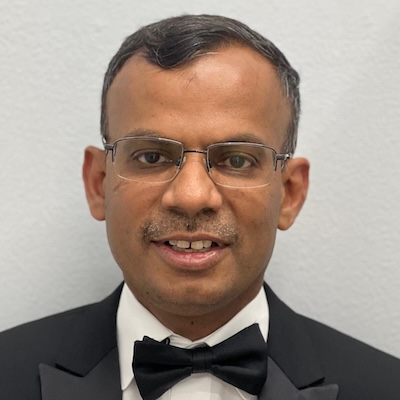
Dr. Sreekanth Pannala is a multidisciplinary technologist and computational scientist focused on “Science without Boundaries.” During 16 years at Oak Ridge National Laboratory (rising to Distinguished Research Staff), he directed $20M+ in DOE-funded programs, led multi-institutional efforts including a $50M Exascale Co-design proposal (4 national labs, 9 universities), and was chief architect for the parallelization of the MFIX software suite, now a global standard with over 7,000 users. As a director-level Research Fellow at SABIC, he invented the ANJEVOC reactor (designed entirely in-silico) and initiated the BLUEHERO vehicle electrification platform (2025 R&D 100 Award). His honors include the Secretary of Energy’s Achievement Award, multiple R&D 100 Awards, and Outstanding Mentor Awards from Siemens and DOE. He holds a B.Tech from IIT Kharagpur and a Ph.D. from Georgia Institute of Technology.

