By Isha Nadig
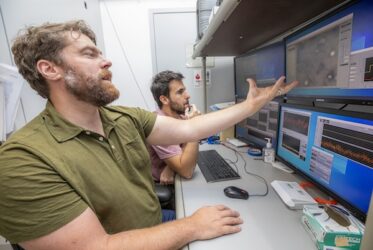
Alex Weber Bargioni, a staff scientist in the Imaging facility, is fascinated by quantum phenomena in materials. With over twenty years at the Foundry and working alongside very talented postdoctoral researchers, he has developed the ability to achieve atomic scale prototyping of two-dimensional quantum materials. Atomic scale prototyping is the ability to control electronic wave functions, the potential landscape that electrons “see”, which ultimately determines the material’s quantum properties such as superconductivity. Weber-Bargioni explains how this concept is synonymous to symmetric water ripples in a still pond. “As a water droplet goes in, you can see these concentric waves emanating. The front of the wave stays constant, while the concentric set of rings moves outwards.” Here, a concentric set of rings is equivalent to a single quantum wave function. In the quantum materials probed by his team, electrons and their wave functions interact with each other to form highly complex patterns.
Weber-Bargioni’s “ultimate daydream” is recreating the complexity of nature: the ability to design materials through the specific arrangement of atoms and molecules at precise locations. These materials represent a promising system for fine-tuning the electronic structure and studying complicated quantum phenomena. The task is far from simple and relies on collaborations from both Foundry staff and users. Within the Imaging facility, he relies on the expertise of staff scientists Archana Raja for advanced 2-D material stacks and optical spectroscopy, Tom Darling for scanning probe microscopy and optical spectroscopy, and Harishankar Jayakumar for quantum optics. The best moments arise when a cross-disciplinary idea takes on a life of its own. “They’re just like, ‘well, have you thought about it this way or that way?’ ” Weber-Bargioni explains. “Suddenly my idea becomes a collective idea, so much better and more thought out than I could have done on my own.” He calls this the “magic interaction”.
The same magic extends to the Foundry’s users. A notable example is his collaboration with Dr. Rebecca Abergel, which began as a user project focused on a fundamental chemistry problem and transformed into a vibrant research portfolio to design next generation quantum emitters for quantum information science (QIS). Specifically, both research groups are exploring how heavy-atoms can be inserted into materials, something Alex notes, “nobody else in the world has the technical abilities to do”. He credits the Foundry’s knowledge-based user facility model for making this type of connection possible. In contrast to neutron source or synchrotron user facilities, “the interaction is more eye-to-eye [and] there’s much more interaction between the user, their PI, and me and my group.” These moments, when a conversation becomes something neither scientist could have imagined alone, are one of the things Alex values most from the past two decades.
In the next twenty years, Weber-Bargioni and his team aim to create increasingly complicated heterogeneous material-architectures that are precisely engineered, atom by atom, to advance QIS research. It is an ambitious goal, and not one anyone pursues alone. At the Molecular Foundry, where “collaboration is not just written up for funding, but lived and breathed everyday”, that has always been the point.

