By Kristopher Benke
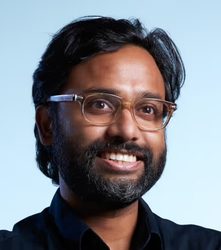
Roger Basu has been a user at the Foundry for 13 years, starting as one of the first employees at Heliotrope Technologies, another start-up launched at the Foundry. He picked up what he could working in industry, both on the job and after hours teaching himself extra electrochemistry, and eventually launched his company Coreshell in 2017 with co-founder Jonathan Tan. The two started out testing early battery prototypes in a warehouse with basic equipment, but soon they realized that in order to make real progress, they had to come back to the Foundry. Now, almost ten years later, they’ve secured funding from the DOE’s Critical Minerals and Energy Innovation grant and are on track to build a gigafactory producing silicon anode batteries.
What first brought you to the Foundry?
Before I founded Coreshell, I worked at a company called Heliotrope Technologies, which also spun out of the Foundry. Back then, former staff scientist Delia Milliron founded Heliotrope with a graduate student of hers based on their work with electrochromic nanoparticles, an innovation that was developed at the Foundry.
I joined Heliotrope as the third employee hired by the founders back in 2013, and that’s where I first saw just how incredible of a resource the Foundry was, especially for getting a startup based in deeply technical materials science and chemistry off the ground. It’s critical to have these kinds of tools available at the early stage, so you can make progress quickly.
When I founded Coreshell in 2017 I was already very well acquainted with folks at the Foundry, and I knew that based on what I wanted to do at Coreshell, it would be an amazing place to accelerate our development. That’s why after Heliotrope, we started our first proposals to do work there for Coreshell back in 2018. What’s amazing about the Foundry is that your proposal is being evaluated by the top scientists in your field, and if it has legs, then you get to come and do work.
Where did the idea come from to start up Coreshell?
It’s common for entrepreneurs at the lab to take a concept they developed in a graduate lab or as a postdoc, but for me, it was an idea I had while working in industry. At Heliotrope, I got my first experience in electrochemistry and started teaching myself more on nights and weekends. I deepened my knowledge about the battery industry and combined that with my previous learnings and expertise from the solar and thin film industry to develop a concept I could apply to batteries.
The initial core technical concept took the form of designing and synthesizing new thin films to apply at the electrode and electrolyte interface within batteries, which is basically where all the bad stuff happens in a battery. Batteries die or lose capacity during cycling because of parasitic reactions that occur at this electrode-electrolyte interface, and so our initial core concept was around engineering these interfaces to improve battery performance and introduce new materials to improve cycle life. Hopefully, that would have knock-on benefits, like improved energy density and safety.
Tell me about the early days at Coreshell. How did you first get it off the ground?
Essentially, my co-founder Jonathan and I founded Coreshell in a warehouse in Richmond out of our savings. We had enough money to get a glove box, a fume hood, and some benches, so we could start doing some chemistry.
That was around the time when it became very apparent that if we wanted to really make progress, we needed to get to the Foundry. For an early stage entrepreneur especially, you have no money. All you have is this concept and the desire to try and prove it out. But you have no access to characterization, and if you don’t have characterization, you really have no idea what’s going on. So, for every step since 2018, having Foundry tools accessible helped us make progress in a way that I think would have been impossible otherwise.
How did you go from funding the company using your own savings all the way to winning a Critical Minerals and Energy Innovation grant from the DOE? What happened in between?
We won an NSF Small Business Innovation Research Phase I grant in 2018, and that was actually the first paycheck that I was able to pay myself. The rest of it was all sweat equity for both me and my co-founder. Looking back on that time, a lot if not most of the data that we put into that 2018 Phase I proposal was generated with the help of the Foundry.
We used Foundry resources to help us get there, and that elevated the quality of the proposal, and I’m certain it played a big role in our ability to win that grant. That was the first stepping stone. We were able to take the Phase I grant, do more research, and win Phase II, which allowed us to hire our first employee, Matthew Kolaczkowski, who came from the lab as well. It’s not just a place for us to go and do characterization but also a place for us to go and meet people and recruit talent.
We won the Phase II grant, and since then we won a DOE Phase I grant, a couple of grants from the California energy commission, like a CalSEED grant, and a bridge grant as well. But the Critical Metals and Energy Innovation grant is the first really big one that is especially focused on manufacturing.
Back to the science–what types of battery systems did you try out first? When did one of your ideas start to show promise for commercialization?
Over the years, we experimented on a number of different material systems. We tried your vanilla, everyday graphite-NMC battery chemistries. We tried some advanced cathode materials and even lithium metal for a while, and then we did a couple of little projects in solid state electrolytes.
But the breakthrough came in around 2020 to 2021, when we really started to make progress in the area of silicon anodes. Silicon has been a holy grail type of material for the battery industry for a long time because it stores 10 times the specific capacity of graphite. So, graphite is the anode in nearly all lithium ion batteries.
If you can replace the graphite with silicon, then you can get a much higher energy density battery. The problem, of course, is that silicon does not cycle well at all. All that lithium has to go somewhere, so it expands the SEI, the solid electrolyte interface, which is this interfacial layer between the electrode and the electrolyte. We made a lot of progress in engineering silicon so that it could cycle long enough that it could actually start to meet product specifications.
We started with 50 cycles, and I think the best cells we’ve ever made are beyond 800 cycles, so that’s now approaching the cycle life for an electric vehicle. As we started to make progress in that area, then the focus of the company really narrowed to making silicon anodes work.
Interested in Becoming a Foundry User?
Join our collaborative, multidisciplinary environment.
Learn more >
How has your work at the Foundry changed since you first started there? What types of questions were you asking then and now?
In the early years, it was all R&D–a lot of method development for thin film growth from solution phase in a controlled fashion. I was trying to make these materials, deposit them on test substrates like silicon wafers and then take them to the Foundry to do AFM and understand the film thickness as a function of the deposition conditions. Or, I would go do ellipsometry on the second floor as another way of determining film thickness and refractive index.
After that, we would do a lot of cell postmortem analysis. After you cycle a battery, it’s very helpful to take the battery apart and try to see what happened on the electrode and ask what kind of chemistry happened on the surface–what were the electrolyte decomposition products that ended up on the surface of the anode and the cathode? What can that tell me about how my coating is interacting with the electrolyte? We used a lot of SEM to answer those questions.
But then in recent years, we used a lot of the organic and polymer characterization tools on the sixth floor, like MALDI, NMR, Raman, and some FTIR, to help us further understand this very complex mosaic of organics and inorganics that form within the battery. That helped us put together a more holistic understanding of what’s actually happening inside the battery.
Because if you don’t really understand what’s going on, then you’re taking shots in the dark. If you throw something in the battery and it makes it worse, or only a little better, you don’t really understand what’s going on. Having that suite of characterization really accelerates and drives our research direction.
How has your company changed over the last few years? What were your priorities and how did they change as you grew?
At first, the team was pretty small and it was really about getting to a proof of concept to show something that worked and was scalable, meaning, are we doing something that works using a technique that’s economically viable? And how much is this going to cost on the dollars per kilowatt-hour basis or the dollars per kilogram basis? Or at the ton scale? Or will it work in a gigafactory?
That was a very important part of our ethos from the very beginning. My co-founder and I both came out of industry, so we had seen other promising technologies that could make a product with good performance but not with good cost. If the economics don’t work out, it’s just not going to be scalable. You can’t really build a business around it without that. We set that rule for ourselves to develop a technology that we can scale.
Then, when we got to that point around 2021, and generated the result in a coin cell, we expanded it. We had to prove to ourselves that we can do this in a single layer pouch cell, then a multi-layer power cell, and finally a 5 amp-hour pouch cell, which is like what you would find in a cell phone. Then we have to prove that we can make 30 of these and that they all perform the same. Then we have to prove that we can take those 30 and deliver them to a customer, and the customer can test them and it works. We had to go through all of these milestones before we had something worth scaling.
In 2020, when we started to actually hire employees, we moved to a couple of suites in the Gate510 facility in San Leandro, about a 3,000 square feet space. Then, in 2023, we made the decision to scale and actually build a four megawatt-hour pilot line to demonstrate that we could scale the technology that we had built using off the shelf lithium-ion battery manufacturing processes that you would see at a gigafactory, but at a smaller scale. So, then we moved to our current facility, which is 23,000 square feet, and built this pilot line and started to actually hire a manufacturing team and a scale-up team.
Tell me more about the pilot line you built in your current facilities and what you’re hoping to achieve next.
In 2024 our equipment came in and we commissioned the pilot line, and then towards the end of last year, we built our first 60 amp-hour prototype. These are the same kind of cells that you would see if you were to drop the pack out of a Chevy bolt and open it up–but you’d just have around 200 of them. It was the first time that we were able to demonstrate that our technology worked in a form factor that actually mirrored what our end customer is putting in their product.
That was a really big proof point for us, and it unlocked our belief that since we did this at four megawatt-hours using off the shelf gigafactory ready equipment, we were ready to take the next step up. That’s when we found out about this opportunity from the DOE earlier this year in the Critical Minerals and Energy Innovation department.
The pilot line was the most important thing that we set up where we are today, and this will continue to be our headquarters going forward, but now we’re basically adding another 100-140,000 square feet to build this gigafactory. It’s wild to think back to the fact that we started this in a warehouse that was attached to a mini storage facility, and now we’re at this point here today.
We couldn’t have done it without the Foundry. When you’re trying to do something in materials science or chemistry, like a deep tech-based innovation, you have to have these kinds of tools available to you, and the Foundry has them, and they’re also all in one place.

